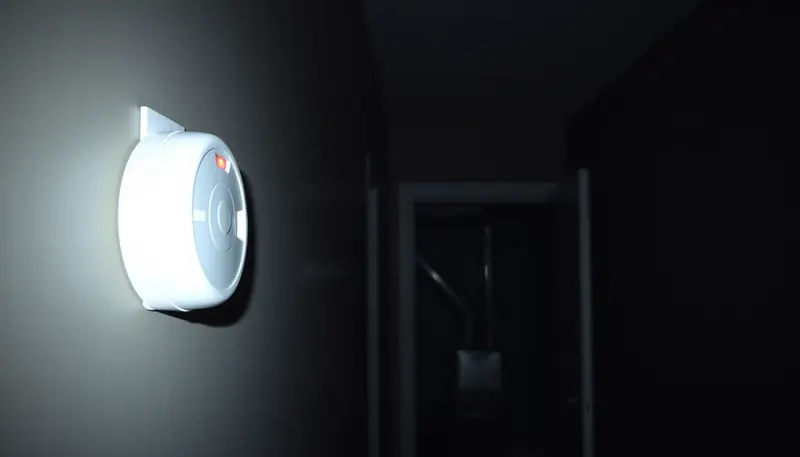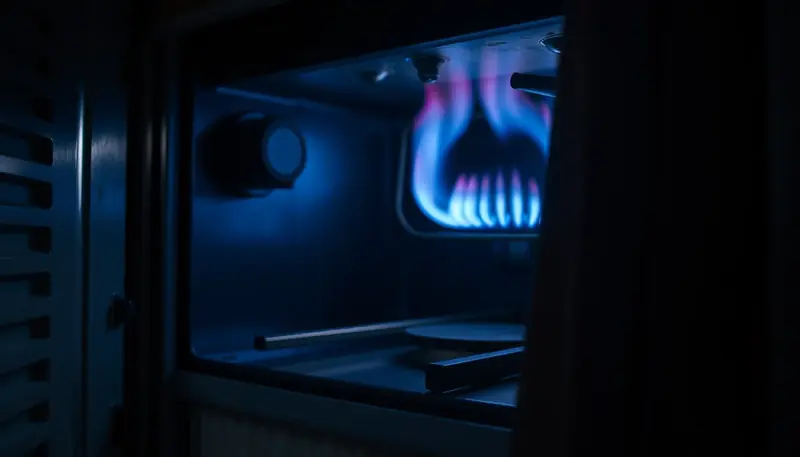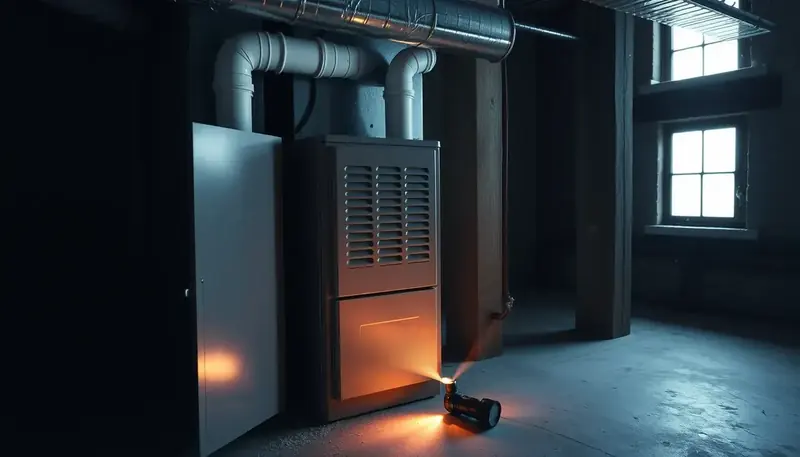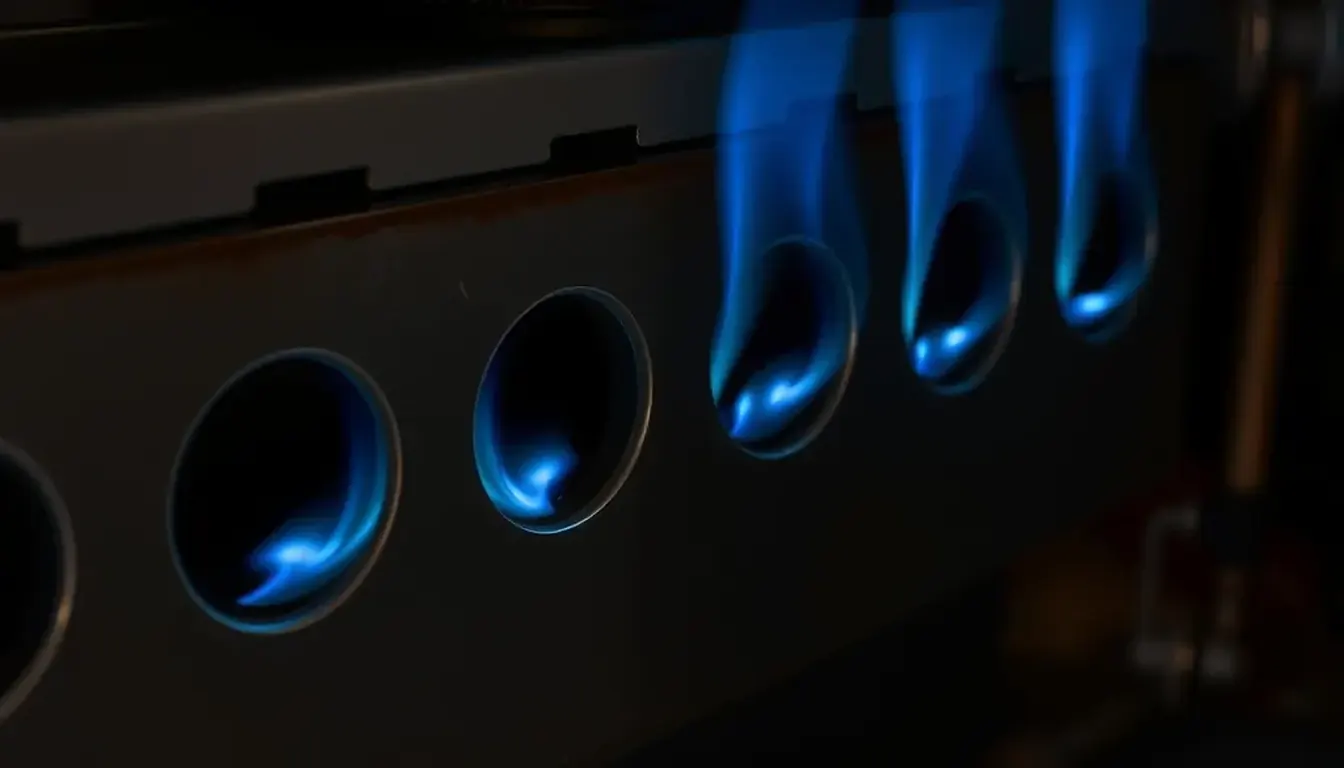
A cracked heat exchanger is a split or rust hole in the metal chamber that keeps furnace exhaust out of your house air. It can let carbon monoxide escape, but many cracks do not. Signs include a CO alarm, soot near the burners and flames that waver when the blower starts. Before replacing anything, ask for proof: camera footage of the crack and CO readings.
What is a cracked heat exchanger?
The heat exchanger is the metal chamber the burner flames fire into. Hot exhaust travels through the inside and out the vent. The blower pushes house air across the outside, and that air carries the heat to your rooms. The metal wall is the only thing keeping the two apart. A crack, a rust hole or a split seam opens a path between them.
Lennox names the usual causes. The metal expands and contracts every cycle until it fatigues. Poor airflow makes the furnace overheat, and a clogged filter is the airflow problem you can fix yourself. Oversized or short-cycling units add stress, and moisture corrodes the walls. High-efficiency condensing furnaces also have a secondary heat exchanger, which is priced as a separate part.
Is a cracked heat exchanger bad, or is it a myth?
Both sides have evidence. A 1996 report by the Canadian Gas Research Institute for Canada Mortgage and Housing Corporation surveyed 41 US and Canadian gas utilities. It states that "in many cases the heat exchanger may be cracked but will not present a threat to the homeowner." It explains why. Most manufacturers, with a few exceptions, design the house air side to run at higher pressure. A small crack then pulls air in rather than letting exhaust out.
The same report lists the catches. Air leaking in can disturb the flame and raise CO. At startup, before the blower runs, the exhaust side can be at the higher pressure, so CO can collect in the duct and spread when the fan comes on. It also cites an Ontario safety bulletin warning that minor cracks can grow into major defects.
The CPSC reviewed 28 investigated CO incidents involving modern gas furnaces from 1987 to 2001. Heat exchanger problems showed up in 14, but in only 3 were they the sole problem. CPSC staff wrote that CO leaks into a home typically take two failures. One makes the furnace produce high CO. The other creates a leak path, such as a crack.
So a crack is a real defect, and whether it is hurting anyone depends on the CO readings. Real harm does happen. Technical Safety BC investigated a home where a heat exchanger with a hole, plus a loose vent pipe, produced 500 ppm of CO at the front door. One person went to hospital.
Cracked heat exchanger symptoms
No single sign proves a crack. Most of these also have other causes, which is why the tests further down matter.
| What you notice | What it can mean | What to do |
|---|---|---|
| CO alarm sounding | CO in the house from some source | Get out, call 911 from outside |
| Headaches, dizziness or nausea that ease when you leave home | Possible CO exposure, per the EPA | Get out, get medical care, have gas appliances checked |
| Flames waver, lift or roll when the blower starts | Blower air entering the flame side, possibly through a crack | Turn the furnace off and book an inspection |
| Rollout switch tripped | Flames leaving the burner area; Lennox lists a cracked or blocked heat exchanger among the causes | Do not keep resetting it; call a technician |
| Soot around the burners, vent or cabinet | Incomplete combustion | Turn the furnace off and book an inspection |
| Rust or corrosion around the furnace or flue pipe | Metal breaking down from moisture | Ask for a camera inspection at the next visit |
| Burning, metallic or chemical smell | Lennox lists it as a warning sign | Turn it off if the smell is strong or new |
Noise is not on Lennox's list of warning signs. A furnace that lights and then shuts off within seconds has its own set of causes, covered in our furnace pressure switch guide.
How to check for a cracked heat exchanger yourself
You cannot confirm a crack yourself. The heat exchanger sits sealed behind the burners. These checks are safe, though, and they give the technician useful facts.
- Test every CO alarm. Press the test button and check the replace-by date on the back. The CPSC wants alarms on every level and outside sleeping areas, but not right above fuel-burning appliances.
- Know what a quiet alarm means. UL-listed alarms are built to stay silent below 30 ppm, Structure Tech notes. A quiet alarm does not prove zero CO. Structure Tech suggests a low-level monitor as a supplement, not a replacement.
- Check the filter. If it is gray and clogged, replace it. Lennox says restricted airflow makes the furnace overheat.
- Watch the flames. If the burner door has a small viewing window, watch during a heat call. Note whether the flames waver or roll when the blower starts. Do not pull the door off while the furnace runs.
- Look for soot and rust. Shine a flashlight around the burners, the vent pipe and the top of the cabinet.
- Check the rollout switch. Some furnaces have a small switch near the burners with a reset button. Lennox says repeat trips mean "you need a technician, not a reset button."
- Note how you feel. The EPA describes CO symptoms as flu-like and clearing up after you leave home.
- Write down the model and serial number. They are on a label inside the furnace door. Turn the furnace switch off before you open any panel. You need these numbers for a warranty claim.
How a technician confirms a crack
A diagnostic guide from Ferguson, a supplier to HVAC pros, compares the main tests. It calls best practice a combustion analyzer reading plus a thorough camera inspection. It says a flame test alone is "not enough to officially condemn a furnace."
| Test | What it shows | Its limit |
|---|---|---|
| Camera (borescope) inspection | The crack itself; easy to photograph | Hairline cracks can hide in tight bends or open only when the metal is hot |
| Combustion analysis | CO and oxygen in the exhaust while the furnace runs | High CO can come from other combustion problems |
| Flame displacement test | Whether the flame moves when the blower starts | Does not locate or confirm a crack |
| Pressure isolation test | Leaks you cannot see | Takes much longer to set up |
| CO in the supply air | Whether CO is reaching your rooms | A clean reading covers only the time of the test |
The supply air test is old practice. The 1996 utility survey found that CO monitoring in the circulating air plenum was the most common "other" test utilities reported.
How to get a second opinion on a cracked heat exchanger
Disputed calls are not new. The 1996 report said many complaints came from "different service personnel giving different opinions on the same furnace." In a 2016 CBS Boston report, a family's furnace was red-tagged during a routine checkup. A second company inspected it with a camera, found no cracks and got normal CO results. The first company could not produce visual evidence beyond a video on the tech's phone.
None of this means your diagnosis is wrong. It means you should see the evidence before you pay for a furnace. Ask for:
- Photos or video of the crack, showing where it is: which tube or cell, and whether it is the primary or secondary heat exchanger. Better yet, watch the camera feed live.
- The combustion analyzer results, as a printout or a photo of the screen: oxygen, CO as measured, CO air-free and flue temperature.
- Whether those readings changed when the blower came on.
- CO readings from the supply air and from the rooms.
- A list of the tests performed.
- The red tag or written report, with the defect, the date, and the technician's name and license number.
- The furnace model, serial number and warranty status.
Then call a separately owned company. Say you want a camera inspection and combustion analysis, not a sales visit. Your gas utility may help too. PG&E, for example, offers free gas appliance safety checks that cover furnaces.
A Massachusetts consumer affairs spokesman told CBS Boston to get a second opinion before buying a system and to call the utility about CO concerns. For warranty work, Carrier's warranty tells owners to contact the installer or a Carrier dealer. Keep the furnace off while you wait. Our no-heat guide covers staying warm safely, and our HVAC quotes guide can help you compare replacement bids.
What do the CO readings on the report mean?
Ask which numbers come from room air, supply air and flue gas. They mean very different things.
| Where measured | Reading | What it means |
|---|---|---|
| Room air, normal home | 0.5 to 5 ppm | Typical in homes without gas stoves (EPA) |
| Room air | 9 to 35 ppm | CO detected: check sources, open windows (BPI) |
| Room air | 36 to 69 ppm | Turn off likely sources, open windows, call a professional (BPI) |
| Room air | 70 ppm or more | Evacuate; call emergency services from outside (BPI) |
| Long exposure | About 1 to 70 ppm | Most people have no symptoms (CPSC) |
| Sustained exposure | Above 150 to 200 ppm | Disorientation, unconsciousness and death possible (CPSC) |
| Home CO alarm | Below 30 ppm | Built to stay silent (UL 2034, per Structure Tech) |
| Home CO alarm | 70, 150 or 400 ppm | Must sound within 60 to 240, 10 to 50 or 4 to 15 minutes |
| Flue gas, air-free | 400 ppm | Widely used upper limit (HVAC School) |
| Flue gas, air-free | Under 100 ppm | Possible and recommended (HVAC School) |
| Supply air vs. return air | Should match | A furnace adds heat to the air, not combustion gas |
The room air bands are the action levels the Building Performance Institute sets for home energy auditors. The EPA adds that even low CO levels can cause chest pain in people with heart disease.
"Air-free" CO is a corrected flue number. The analyzer adjusts the raw reading for the extra air mixed into the exhaust, so the air-free figure always comes out higher. HVAC School gives the formula. When you compare two reports, compare air-free to air-free.
How to read two techs who disagree
- Crack on camera, normal CO everywhere: the defect is real, but the immediate risk looks low. Lennox still advises shutting a furnace with a cracked heat exchanger off. Use that time to check the warranty and compare quotes.
- High flue CO, no visible crack: the CO problem is real but may sit elsewhere, such as the burners, gas pressure or venting. Ferguson notes high CO can come from other combustion problems. Fix the cause, then retest.
- CO rising in the supply air: treat it as a confirmed hazard and leave the furnace off until it is fixed.
- Flame wobble only, no photo, no readings: by Ferguson's standard, that is not enough to condemn a furnace. Ask for the tests.
Can a cracked heat exchanger be repaired?
Not by patching. Lennox says that because the heat exchanger is a sealed component, "repairs are rarely recommended." The fix is a new heat exchanger or a new furnace.
The part is often under warranty. Carrier's limited warranty for its non-condensing gas furnaces covers the heat exchanger for 20 years, for original and later owners. It excludes labor for diagnosing, removing and installing parts. It also excludes damage from corrosive environments and faulty installation, and it requires normal care and maintenance. Other brands' terms differ, so check yours with the model and serial number.
Age decides the rest. HVAC.com suggests replacing the whole furnace if it is more than 10 years old when the heat exchanger fails. Bob Vila suggests replacing only the heat exchanger on a furnace under 10 years old with no other problems. Carrier says most gas furnaces last about 15 to 20 years.
How much does a cracked heat exchanger cost to fix?
Published ranges disagree, so treat them as a starting point for quotes.
| Job | Reported range | Source |
|---|---|---|
| Heat exchanger replacement, parts and labor | $1,000 to $2,000, average about $1,500 | Bob Vila (2023) |
| Heat exchanger replacement | $2,000 to $3,000 | HVAC.com (2023) |
| Heat exchanger part only | $350 to $850 | Bob Vila |
| Labor only, part under warranty | $400 to $600 | Bob Vila |
| Secondary heat exchanger, installed | $1,000 to $2,000 | Bob Vila |
| New natural gas furnace, installed | $3,800 to $10,000 | Carrier (2026) |
Note the gap: HVAC.com's low end is Bob Vila's high end, and both pages date from 2023. Get written quotes that name the part, the labor hours and whether the part comes under warranty. If the quote is for a whole furnace, ask why the heat exchanger alone is not an option.
Call a pro now if
- A CO alarm sounds or anyone feels sick. Call 911 from outside first.
- You smell gas. Leave and call the utility from outside.
- Flames roll out of the burner area, or the rollout switch has tripped more than once.
- There is fresh soot on the furnace, the vent or the ceiling near it.
- A technician measured CO in your supply air.
- The furnace is tagged and you need heat. Book the second opinion now instead of reopening the gas.
Questions people ask
Can a cracked heat exchanger kill you?
It can contribute to carbon monoxide poisoning, which the CPSC says can cause disorientation, unconsciousness and death at sustained levels above 150 to 200 ppm. CPSC staff found that furnace CO leaks typically take two failures: a furnace making high CO, plus a leak path such as a crack. Working CO alarms on every level are your backstop.
Can you run a furnace with a cracked heat exchanger?
Not until it has been properly tested. If a technician or the gas utility tagged it, leave it off and do not reopen the gas valve. Research for Canada Mortgage and Housing Corporation found many cracks pose no immediate threat, but cracks can grow, and you cannot tell from the outside which kind you have.
Does a cracked heat exchanger make noise?
Not in a way you can reliably pick out. Lennox's list of warning signs covers CO alarms, odors, soot, rust, short cycling and physical symptoms, but not noise. A new bang or rattle is worth reporting to a technician, but on its own it is not a sign of a crack.
Is a cracked heat exchanger covered by warranty?
Often the part is. Carrier's limited warranty for its non-condensing gas furnaces covers the heat exchanger for 20 years, for original and later owners. It does not cover labor, which Bob Vila puts at $400 to $600 for this job. Terms vary by brand and model, so check yours with the model and serial number.
Is the cracked heat exchanger scam real?
Disputed diagnoses do happen. A 1996 report for Canada Mortgage and Housing Corporation said many furnaces may be red-tagged unnecessarily, and CBS Boston reported in 2016 on a family whose second opinion found no crack. Real cracks happen too. Ask for camera footage of the crack and the CO readings, then get a second opinion from a separate company.
Sources
- CPSC: Carbon Monoxide Questions and Answers
- CPSC: In-Depth Investigations of CO Incidents Associated with Modern Gas Fired Furnaces (2002)
- EPA: Carbon Monoxide's Impact on Indoor Air Quality
- CMHC and Canadian Gas Research Institute: Survey of North American Heat Exchanger Integrity Test Methods (1996)
- Building Performance Institute: Combustion Appliance Safety Inspection, ambient CO action levels from ANSI/BPI-1200
- Lennox: Cracked Heat Exchanger in a Furnace
- Lennox: Flame Rollout Switch
- Ferguson: Furnace Heat Exchanger Diagnostics
- Carrier: Limited Warranty for Non-Condensing Gas Furnace (09/22)
- Carrier: Gas Furnace Replacement Guide
- Bob Vila: Heat Exchanger Replacement Cost
- HVAC.com: Furnace Heat Exchanger Replacement
- HVAC School: What Does Air Free CO Mean?
- Structure Tech: Low levels of carbon monoxide will not set off UL listed CO alarms
- CBS Boston: I-Team furnace scam and carbon monoxide report (2016)
- Technical Safety BC: Cracked heat exchanger on residential furnace results in carbon monoxide exposure
- PG&E press release via ContraCosta.news: Free gas appliance safety checks (2025)