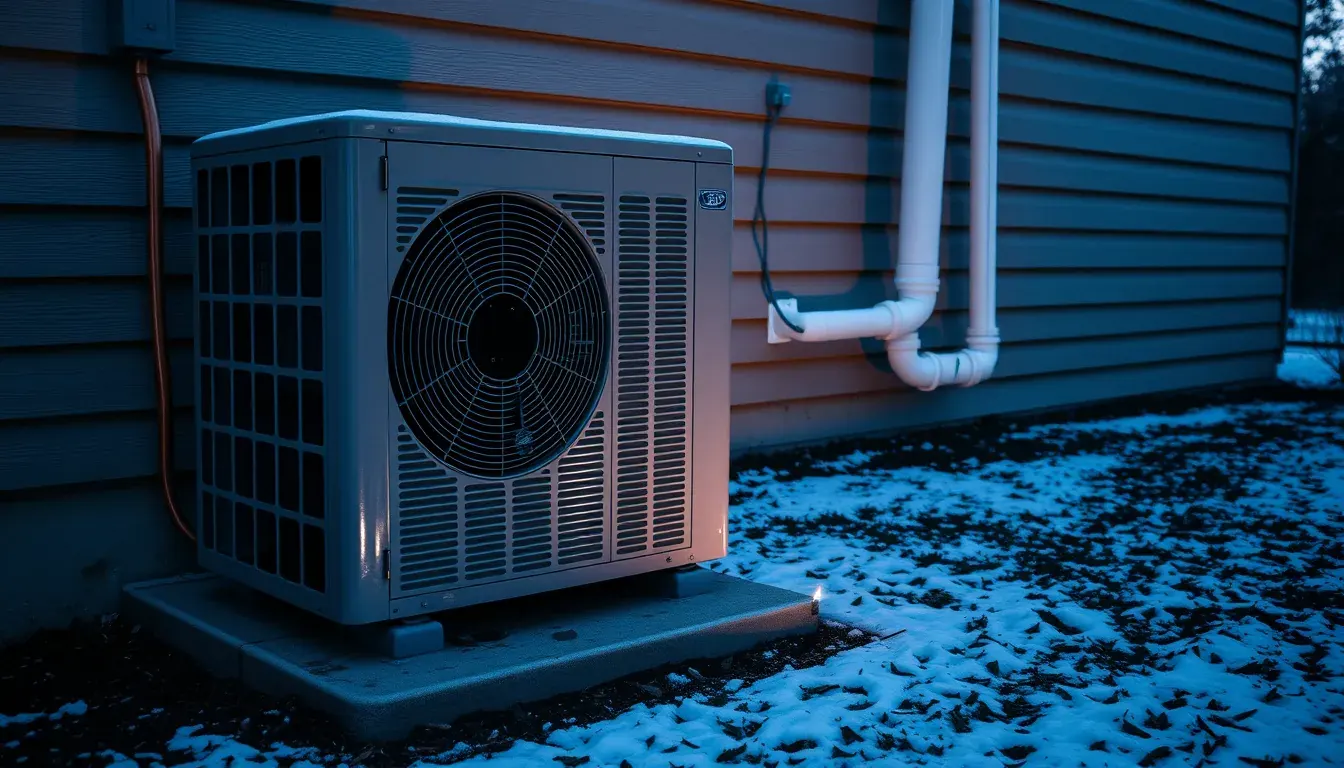
A dual fuel heat pump is an electric heat pump paired with a gas or propane furnace on the same ducts. The heat pump cools in summer and heats in mild weather. Below a set outdoor temperature, the controls shut it off and run the furnace. Carrier says the switch typically comes at 35°F to 40°F. Fixr reports $7,500 to $12,000 installed.
Whether it pays off depends mostly on your electric and gas prices. In an analysis for the Northwest Energy Efficiency Alliance (NEEA), presented in March 2026, a basic heat pump in place of the AC cut a modeled Portland home's yearly heating and cooling bill from $1,093 to $842. The same setup came out $14 a year worse in Missoula, where gas is cheaper. On propane, a heat pump sized for a 20°F switchover saved about $1,030 a year.
How a dual fuel heat pump system works
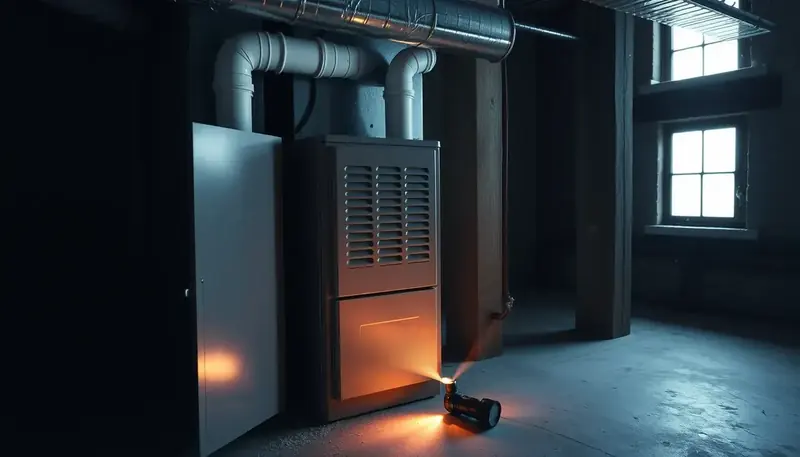
The outdoor heat pump connects by refrigerant lines to an indoor coil that sits in the ductwork just downstream of the furnace. The furnace blower moves air across that coil for both heating and cooling. That is how Minnesota's Center for Energy and Environment (CEE) describes the dual fuel systems it tested. Price guides also call it a hybrid heat pump, and Carrier sells it as Hybrid Heat.
In summer, Trane says, the heat pump works like an air conditioner. In winter it heats until the outdoor temperature drops far enough that it gets less efficient. Then the gas furnace takes over, and the heat pump comes back when it warms up.
A control makes that call. PNNL's federal energy FAQ says it chooses based on outdoor temperature, the relative efficiency of each unit, and the cost of each fuel. The pair can be pieced together from a standard heat pump and a furnace, or bought as one integrated unit.
The integrated version is a dual fuel package unit. Trane's EarthWise Hybrid puts a heat pump and a gas furnace in one unit. ENERGY STAR's heat pump criteria cover single-package equipment, including gas/electric package units, at 15.2 SEER2 and 7.2 HSPF2 or better.
Can a heat pump and gas furnace run at the same time?
Not in a standard dual fuel system. Trane says the heat pump and furnace never run at the same time. Gree's 2026 setup guide explains why. Running both overheats the indoor coil, causes pressure spikes, and trips a protection shutdown. The coil sits on the supply side, in the furnace's hot outlet air.
An older Carrier dual fuel thermostat manual says the same, with one exception: defrost. It also calls for a high-pressure switch on the heat pump, to protect it if a failure ever ran both at once. Brands handle defrost differently. Carrier's manual brings the furnace on during defrost. Gree says its defrost lasts about two minutes, too short for the furnace to light, so the furnace stays off.
Systems that run both on purpose exist, but they are built differently. NEEA's analysis says simultaneous gas and heat pump heating needs special system designs that are not yet common. Oak Ridge National Laboratory has modeled one that sends air through the heat pump coil first and the gas heat second. Conventional dual fuel systems, ORNL says, run either the furnace or the heat pump at any given moment.
What switchover temperature should a dual fuel heat pump use?
Three temperatures matter, per Carrier's thermostat manual. The thermal balance point is where the heat pump can just keep up with the house's heat loss. The economic balance point is where heat from the furnace and heat from the heat pump cost the same. The comfort balance point is where heat pump air starts to feel too cool. The switchover is the setting the installer actually programs.
Published advice on that setting varies a lot:
| Source | What it says about the switchover |
|---|---|
| Carrier glossary (2026) | Typically 35°F to 40°F |
| Carrier dual fuel thermostat manual (1996) | 25°F to 45°F for most homes; selectable from 15°F to 55°F |
| Trane | Around freezing for a standard heat pump; single digits or below zero for a cold-climate model |
| NEEA analysis (presented 2026) | Size the heat pump to about a 30°F balance point and switch a few degrees above it; 20°F or lower with propane |
| CEE Minnesota field study (2018) | 10°F in most test homes and 5°F in one, with cold-climate heat pumps and propane furnaces |
| Gree (2026) | Calls the old 35°F to 40°F rule outdated; depends on region, utility rates and fuel |
NEEA found the switchover was the largest lever on gas use. In its Portland model, the furnace burned 105 therms a year with a 30°F switchover, 154 therms at 35°F, and 309 therms at 40°F. Its advice is to set the switchover a few degrees above the heat pump's balance point. Any higher, it says, is a wasted investment in heat pump equipment.
Carrier's manual gives the other side. Set too high, the heat pump is not used enough. Set too low, the house loses ground while the heat pump struggles. If your gas is cheap and your power is expensive, a higher setting can still be the cheaper one. Run the numbers below before you accept a default.
How to find your break-even temperature
You need two prices from your bills and two efficiency numbers. The EIA lists 1 kilowatthour at 3,412 Btu and 1 therm at 100,000 Btu. So a therm of heat equals about 29.3 kWh.
- Get your prices. Find the per-unit electric price per kWh and gas price per therm on your bills. Skip the fixed monthly fees, since they do not change with use.
- Get your furnace efficiency. Its AFUE is on the rating plate or spec sheet. Write it as a decimal, such as 0.80 or 0.95.
- Do the math. Multiply the electric price by 29.3 and by the AFUE. Divide by the gas price. The result is the break-even COP.
- Compare. Ask your installer at what outdoor temperature your heat pump's COP drops below that number. Above that temperature, the heat pump is the cheaper heat.
Check it with NEEA's 2023 Washington and Oregon rates: $0.1157 times 29.3 times 0.95, divided by $1.507, gives about 2.1. That matches NEEA's figure. With cheaper Idaho and Montana gas, NEEA got 3.4. Against propane it was only 1.3, and NEEA notes its basic heat pump's COP of 2.9 was well above that.
For propane, use 26.8 in place of 29.3 and your price per gallon. The EIA puts a gallon of propane at 91,452 Btu.
Heat pump efficiency falls as it gets colder. ENERGY STAR requires a cold-climate model to keep a COP of at least 1.75 at 5°F and at least 70% of its 47°F heating capacity. Ask for the manufacturer's extended performance table for your exact outdoor unit and coil.
AC with a furnace, or a dual fuel heat pump?
A heat pump cools like a central air conditioner, so the choice is really about winter. NEEA modeled a gas furnace with AC against the same furnace with a heat pump in place of the AC. These are its yearly heating and cooling costs at 2023 EIA rates:
| Modeled home (NEEA) | Yearly operating cost |
|---|---|
| Portland, gas furnace and AC | $1,093 |
| Portland, furnace and single-speed heat pump, 35°F switchover | $842 |
| Portland, furnace and low-load-efficient variable-speed heat pump, 35°F switchover | $688 |
| Missoula, furnace and single-speed heat pump, 35°F switchover | $14 more than furnace and AC, with 2,293 lb less CO2 a year |
| Missoula on propane, furnace and AC | $3,324 |
| Missoula on propane, furnace and a larger single-speed heat pump, 20°F switchover | $2,294 |
NEEA's summary was that dual fuel is never a bad choice against that baseline, because it always lowers either operating cost or emissions. It called the case compelling in Washington and Oregon and with delivered propane, and far less so where gas is cheap. It put the extra install cost at multiple thousands of dollars, outside its study scope.
It also found that a heat pump's performance below 30°F matters little in a dual fuel system, because the gas furnace runs then. Heat pumps with good efficiency at low loads paired best. By the same logic, cold weather performance starts to matter when you plan a low switchover, as NEEA suggests for propane.
Timing matters as much as rates. CEE's Minnesota field study found homeowner cost savings of 30% to 56% across its test homes, which had propane or electric heat. Propane use fell about 60% in the dual fuel homes. Retrofit paybacks ran longer than 10 years, but dropped to 5 to 6 years when the old heating or cooling equipment had failed anyway.
So the cheapest moment to choose dual fuel is when your AC is due for replacement. You were buying an outdoor unit anyway, and Carrier names upfront cost and installation complexity as the main drawbacks. One more limit: Trane notes that the furnace needs electricity too, so a gas backup is not a power outage backup.
How much does a dual fuel heat pump cost?
Price guides disagree, and none we could read is current to 2026. Fixr reports $7,500 to $12,000 installed, and about $9,500 for a 3-ton heat pump with a gas furnace in a 2,000 square foot home. Its page was updated in January 2025. Fixr puts adding a heat pump to a furnace in good shape at $2,500 to $8,000, and labor at $2,000 to $4,000.
Bob Vila lists hybrid heat pumps at $2,500 to $10,000 for materials and labor, in a guide updated in April 2024. Fixr's conversion figure assumes you keep a working furnace. Its high end, $15,000, covers a dual fuel system with new ducts.
Sizing moves the price too. CEE sized its heat pumps for the heating load, which typically meant one ton larger than sizing for cooling. NEEA found that in most Northwest climates, sizing for cooling already lands near its 30°F target. If you keep your furnace, Carrier says a technician should check its blower motor, the ductwork and thermostat compatibility first.
The federal tax credit is gone for new installs. The IRS says the Energy Efficient Home Improvement Credit, up to $2,000 a year for qualifying heat pumps, covered improvements made through December 31, 2025. Utility and state rebates still exist. Search by ZIP code in the ENERGY STAR Rebate Finder. Philadelphia readers can see current PECO heat pump and PGW furnace rebates on our Philadelphia page.
Get at least two written quotes that name the switchover setting and the thermostat. Our guide to comparing HVAC quotes covers what else to ask.
Mixed-brand hybrid system: how bad is it?
A heat pump from one brand and a furnace from another can work as dual fuel. The control is ordinary 24-volt wiring through a dual fuel thermostat or a separate dual fuel kit. Gree's guide says a standard thermostat will not work. It must be set up for dual fuel, so it shuts the heat pump off whenever it calls the furnace.
What you give up is coordination. Gree notes that it does not control how another maker's furnace board sets blower speed. So your installer has to confirm the furnace blower delivers full airflow when the heat pump is heating. Gree also notes that another brand's furnace does not join its H1/H2 data link, which carries diagnostic data.
Ratings and rebates are the other catch. AHRI certifies split systems as combinations, not as individual units, and gives each one a Certified Reference Number. It says its certificates may be required for rebates, incentives and tax credits. Before you sign, ask for the AHRI certificate that matches your exact outdoor and indoor equipment. Then confirm your rebate program accepts it, and ask in writing whether the pairing affects either warranty.
What furnace works in a fully communicating dual fuel setup?
A communicating system needs a matched set from one brand: heat pump, furnace and control. Carrier says its Infinity System Control is designed exclusively for the Infinity system, including Hybrid Heat, its dual fuel setup. Trane says its Link UX360 works with Trane variable-speed communicating systems. It says it does not work with other brands or with standard single-stage, two-stage or multi-speed equipment.
So the furnace has to be that brand's communicating model. For Trane Link, that means a variable-speed communicating furnace. Check the furnace model number against the control's compatibility list before you buy. If you want mixed brands or a third-party thermostat, plan on conventional 24-volt dual fuel control instead.
Dual fuel heat pump not switching: quick checks
These checks use the thermostat, the breaker panel and the filter slot. Do not open the furnace or the outdoor unit.
- Read the outdoor temperature. Compare what the thermostat shows with the real weather. A wrong reading moves the switchover. A Bonneville Power Administration sheet says the Honeywell T6 Pro needs a wired outdoor sensor for its lockout features to work.
- Find the switchover setting. On an ecobee, BPA shows it under Menu, Settings, Installation Settings, Thresholds, as Compressor Min Temperature and Aux Heat Max Outdoor Temperature. On a T6 Pro it is installer setting 355, Compressor Lockout/Balance Point. Write values down first. BPA warns that pressing + or - in installer setup changes settings.
- Watch one cycle. Above the switchover, the outdoor fan and compressor should run. Below it, the outdoor unit should stop and the furnace should light. Rheem's kit manual describes this handoff.
- Allow for defrost. Steam from the outdoor unit and a stopped outdoor fan are normal for a few minutes. Carrier says a defrost cycle lasts about 5 to 10 minutes.
- Check both breakers. Carrier notes the outdoor unit and the indoor unit have separate breakers. A breaker that has tripped is a job for a technician.
- Change the filter. Both halves of the system push air through it. Carrier's glossary suggests a change every 1 to 3 months, depending on the filter.
- Use emergency heat if the heat pump fails. Carrier's dual fuel thermostat manual says emergency heat makes the furnace do all the heating. Check your own thermostat's manual, then book service.
If the furnace itself will not light, our no heat in the house guide walks through the furnace checks.
What each symptom usually means
| What you see | What it usually means | What to do |
|---|---|---|
| Furnace runs on mild days, heat pump rarely does | Switchover set high, or a wrong outdoor reading. Carrier says a high setting means the heat pump is not used enough. | Check steps 1 and 2; ask your installer to lower it |
| Heat pump runs in deep cold and the house falls behind | Switchover set below the heat pump's balance point. Carrier says the house gets uncomfortable. | Raise it a few degrees, per NEEA's advice |
| Steam and a quiet outdoor fan for several minutes | Defrost | Normal; Carrier says 5 to 10 minutes |
| Cool air for a minute or two during defrost | Normal on systems that keep the furnace off in defrost, as Gree describes | Wait it out; call if it does not pass |
| Outdoor unit and furnace both running in heat mode, outside of defrost | Wiring or control fault | Turn the system off at the thermostat and call |
| Ice thicker than 1/4 inch, or ice that stays after defrost | Not normal, per Carrier | Emergency heat, then call |
| Neither unit heats | Breaker, thermostat setup or a furnace fault | Steps 5 and 7, then call |
Safety limits for a heat pump with gas backup
That advice comes from Connecticut's utility regulator. A dual fuel system still burns gas, so it still needs CO alarms. The CPSC says to put them on every level of the home and outside sleeping areas. It says more than 200 people in the United States die each year from accidental non-fire CO poisoning. If you suspect CO, get outside to fresh air, then call 911.
Our furnace carbon monoxide guide covers the warning signs. Both halves of the system need yearly service. Trane recommends annual check-ups, and our furnace tune-up guide lists what a real one includes.
Refrigerant work is never DIY. The EPA requires Section 608 certification for technicians who maintain, service, repair or dispose of equipment that could release ozone-depleting refrigerants. Under its sales restriction, only certified technicians can buy refrigerant for stationary systems like home HVAC, non-ozone-depleting substitutes included. Wiring stays with a pro too. Rheem's kit manual says to shut off all electrical power to the units before installing or servicing them.
Call a pro now if
- You smell gas or a CO alarm sounds. Leave first and call from outside.
- The outdoor unit and the furnace heat at the same time outside of a short defrost.
- A breaker for the heat pump or the furnace has tripped.
- Ice thicker than 1/4 inch stays on the outdoor coil after defrost.
- The furnace locks out or will not light, even on emergency heat.
- The heat pump coil sits on the return side of the furnace, or you are not sure which side it is on.
- You want to add a heat pump to your furnace. The coil, blower check, refrigerant lines and thermostat wiring all need a licensed installer.
Questions people ask
Is a dual fuel heat pump worth it?
It depends on your electric and gas prices. A NEEA analysis presented in 2026 found a dual fuel system cut a modeled Portland home's yearly bill from $1,093 to $842, but cost $14 a year more in Missoula, where gas is cheap. On propane, a larger heat pump saved about $1,030 a year. Minnesota's CEE found paybacks of 5 to 6 years when the old equipment needed replacing anyway.
Can I add a heat pump to my existing gas furnace?
Often, yes. Fixr reports $2,500 to $8,000 to add one to a furnace in good condition. Carrier says a technician should first check the furnace blower motor, the ductwork and thermostat compatibility. The heat pump coil must sit on the furnace's supply side, and you need a dual fuel thermostat or kit so the two never run together.
Does a dual fuel heat pump need a special thermostat?
Yes. Gree's 2026 setup guide says a standard thermostat will not work. You need one set up for dual fuel, which shuts the heat pump off whenever it calls the furnace and switches by outdoor temperature. Older systems used a separate dual fuel kit. Communicating systems from Carrier and Trane use the brand's own control.
What does emergency heat do on a dual fuel system?
On a dual fuel thermostat, emergency heat normally locks out the heat pump and heats with the furnace alone. Carrier's dual fuel thermostat manual says all heating is then done by the furnace. Use it if the heat pump has failed, then book service. Setups vary, so check your own thermostat's manual.
Does a dual fuel system work in a power outage?
No. Trane notes that dual fuel systems rely on electricity for the furnace as well as the heat pump. A gas furnace backup is not a power outage backup. If outages are common where you live, plan for backup power that can run the furnace.
Is dual fuel a good idea with propane?
Usually it is the strongest case. NEEA's analysis found a heat pump only needs a COP of 1.3 to beat propane on cost, and it recommended a 20°F or lower switchover. In Minnesota, CEE measured about 60% less propane use in homes with cold-climate heat pumps backed by propane furnaces, which it said limits costly winter refills.
Sources
- Carrier: What Is a Dual Fuel Heat Pump? (HVAC glossary, reviewed October 2026)
- Carrier: Keeping Homes Warm (Hybrid Heat dual-fuel case study)
- Carrier: Programmable Dual Fuel Thermostats, Installation, Start-Up, and Operating Instructions (Form TSTAT-9SI, 1996)
- Carrier: Heat Pump Not Heating? (September 2026)
- Carrier: Infinity System Control (SYSTXCCITC01-C)
- Trane: Is a Dual Fuel Heating System Right for You?
- Trane: How Does a Heat Pump and a Furnace Matched System Work?
- Trane: EarthWise Hybrid Dual Fuel Packaged Systems
- Trane: Link UX360 smart thermostat
- Gree Comfort: Dual Fuel Setup, Wiring and Configuration Guide (March 2026)
- Rheem: Dual Fuel Kit Installation Instructions (7077650, 1998)
- PNNL, Facility Energy Decision System: What is a dual-fuel heat pump?
- Oak Ridge National Laboratory via OSTI: Hybrid Heat Pump Controls, Conventional Dual Fuel versus Seamlessly Fuel Flexible Heat Pump (2022)
- NEEA, Larson Energy Research: Dual-Fuel Gas Furnace + Heat Pump System Control Analysis (slides, March 2026; report E25-347, September 2025)
- Center for Energy and Environment (Minnesota): Field Assessment of Ducted and Ductless Cold Climate Air Source Heat Pumps, ACEEE Summer Study (2018)
- ENERGY STAR: Air Source Heat Pumps Key Product Criteria
- ENERGY STAR: Rebate Finder
- U.S. Energy Information Administration: British thermal units (Btu)
- AHRI: How and Why of Certified
- Bonneville Power Administration: PTCS Heat Pump Thermostat Support Sheet, Honeywell T6 Pro
- Bonneville Power Administration: PTCS Heat Pump Thermostat Support Sheet, ecobee 3 Lite, 4 and 5
- IRS: Energy Efficient Home Improvement Credit (reviewed April 2026)
- EPA: Section 608 Technician Certification
- EPA: Refrigerant Sales Restriction
- CPSC: Carbon Monoxide Information Center
- Connecticut PURA: What to Do If You Smell Natural Gas (March 2026)
- Fixr: How Much Does It Cost to Install a Dual Fuel Heat Pump? (updated January 2025)
- Bob Vila: How Much Does a Heat Pump Cost? (updated April 2024)