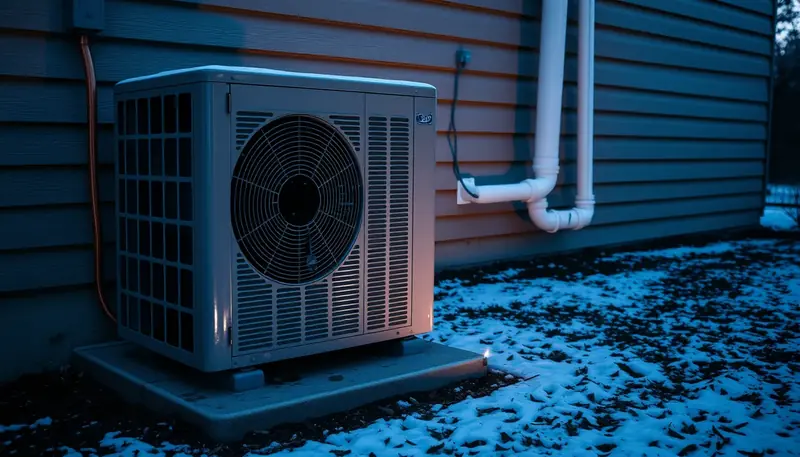
Jacksonville's air conditioner does most of the work. NOAA's 1991-2020 normals for Jacksonville International Airport show 2,803 cooling degree days a year and 1,228 heating degree days. Replacing an AC unit needs a City of Jacksonville permit, and Florida's new $7,500 permit exemption excludes mechanical work. Florida's federal home energy rebates have not opened.
How hard does Jacksonville's climate work an AC or heat pump?
The figures below come from NOAA's annual normals and monthly normals for the airport station, covering 1991 to 2020. July's normal high is 91.9°F. January's normal low is 42.9°F.
| 1991-2020 normal, Jacksonville International Airport | Value | What it means for your equipment |
|---|---|---|
| Cooling degree days (base 65°F) | 2,803 a year | Cooling is the bigger job. May through September account for about 2,260 of them. |
| Heating degree days (base 65°F) | 1,228 a year | A modest heating load. December through February account for about 870. |
| Days at 90°F or hotter | About 80 a year | Long compressor run times all summer |
| Days at 100°F or hotter | Fewer than 1 a year | Summer heat is steady rather than extreme |
| Nights at 40°F or colder | About 46 a year | Real heating demand on winter mornings |
| Nights at 32°F or colder | About 14 a year | A heat pump leans on its backup heat on the coldest nights |
Humidity changes how that load should be met. DOE puts Florida in its "hot-humid" Southeast region for air conditioner standards. A DOE Building America guide from two national laboratories explains why size matters there. An oversized unit cools the air past the set point and shuts off before it has removed the moisture. The guide blames rules of thumb. It tells contractors to work out the load with ACCA Manual J and pick the equipment with Manual S. Ask for the Manual J printout along with your quote.
Two settings also matter in a humid house, according to the same DOE guide. The indoor fan should be set to "Auto," not "On." Many newer units keep the fan running for about two minutes after the compressor stops. That lets water sitting on the cold coil evaporate back into your air. The guide says the delay should be 30 seconds or less in humid climates. Ask the installer to check it at startup.
Heat pumps and backup heat in Jacksonville
The DOE guide says a standard air-source heat pump's heating efficiency drops once it is colder than about 35°F outside, so a backup source is often needed. In an all-electric system, the backup is a set of resistance heat strips. January's normal low at the airport is 42.9°F, above that point. The airport also averages about 14 nights a year at 32°F or below, and the strips will carry part of the load then. Ask how they are sized and what tells them to turn on.
If your home heats with electric resistance today, such as an electric furnace or baseboard heaters, the same guide says a heat pump can trim heating electricity by as much as 30% to 40%. If you have gas, a dual-fuel system pairs a heat pump with a gas furnace as the backup. Our guide to dual-fuel heat pumps covers how the switchover works.
What efficiency a new system must meet
Florida falls under DOE's Southeast rules. The 2023 standards FAQ sets split-system air conditioners below 45,000 Btu per hour at 14.3 SEER2, and larger ones at 13.8 SEER2. Split heat pumps need 14.3 SEER2 and 7.5 HSPF2. DOE says it is illegal for a contractor to install an air conditioner below the Southeast standard, and you can report one to [email protected]. Check the rating of the matched outdoor and indoor units, as our guide to reading HVAC quotes explains.
What HVAC rebates can Jacksonville homeowners get in 2026?
Money can come from your electric utility, your gas utility and the state energy office. Status as of November 5, 2026, from each program's own page:
| Program | What it offers | Who qualifies | Status |
|---|---|---|---|
| JEA residential rebates | $200 for a heating and cooling system; $50 for an HVAC tune-up; $50 for a smart thermostat | JEA customers; the system rebate requires a JEA pre-qualified contractor | Listed on JEA's rebate page |
| Peoples Gas furnace rebate | $725 if the furnace replaces electric heat; $500 if it replaces gas equipment | New equipment, applied for within a year of installation | Listed; Peoples Gas may change or end it without notice |
| Florida Energy Saver Program (federal HOMES and HEEHR) | No heat pump amount posted | HOMES: predicted savings of at least 20%. HEEHR: income under 150% of area median | Not open; no launch date |
| Federal 25C tax credit | Ended | Improvements made through December 31, 2025 | Not available for 2026 installs |
JEA, the electric utility
If you are a JEA customer, JEA's residential rebate page lists a $200 rebate for a heating and cooling system, a $50 rebate for an HVAC tune-up and a $50 rebate for a smart thermostat. The system rebate is marked with an asterisk, and the page says upgrades marked that way "require the use of a JEA pre-qualified contractor." The tune-up and thermostat rebates carry no asterisk. The same page lists a $25 instant discount on a room air conditioner.
The main rebate page does not spell out which systems qualify or how often one home can claim. Those terms sit on JEA's heating and cooling details page, which asked our automated reader to pass a human check on November 5, 2026. Open it yourself before you sign, and ask your contractor to confirm in writing that they are on JEA's pre-qualified list.
The Peoples Gas furnace rebate
The Peoples Gas rebate page, which lists Jacksonville among its Florida areas, offers $725 for a gas furnace that replaces electric heat and $500 for one that replaces existing gas equipment. For the higher amount, the installer's invoice must say "electric to gas," or you can give the model and serial number of the old electric unit. The rebate cannot exceed what you paid for the equipment, installation, piping and venting.
Timing matters. On the same page, equipment installed more than a year before you apply does not qualify, and neither does used or refurbished equipment. Peoples Gas says processing takes 6 to 8 weeks and that it may change or end the program without notice. If your contractor collects the rebate, you sign the invoice to assign it to them.
State and federal money
Florida runs the federal Home Energy Rebates through its Department of Agriculture and Consumer Services, as the Florida Energy Saver Program. It is not open. The site says applications "are expected to open in the future" and offers an email alert. The whole-home HOMES track covers upgrades predicted to save at least 20% of a home's energy use. The HEEHR track is limited to households under 150% of area median income. Rebates will come as a discount on work done by a qualified contractor.
The program's FAQ page posts no fixed heat pump amount. It says the rebate varies and that not everyone will qualify, since eligibility rests partly on household income. DOE's Home Energy Rebates page sends homeowners to their state energy office for status. If a contractor says this money is available now, ask for the program name and check the state's site.
The federal tax credit is closed to new installs. The IRS says the Energy Efficient Home Improvement Credit covers improvements made through December 31, 2025. A system installed in Jacksonville in 2026 does not qualify.
Do you need a permit to replace an AC or furnace in Jacksonville?
Yes. The city's residential permits page cites Florida Building Code Section 105.1, which requires a permit before anyone installs, alters, repairs or replaces a mechanical system. The Building Inspection Division's FAQ names "air conditioning units" among the replacements that need one. A few jobs are exempt: replacing a part inside a single piece of equipment, hooking up portable heating or ventilation units, and self-contained refrigeration systems holding 10 pounds of refrigerant or less.
Florida's new small-job exemption does not cover HVAC. HB 803 was approved by the Governor on May 6, 2026 and took effect July 1. It makes local governments exempt some single-family work valued at $7,500 or less. The Senate bill summary says that exemption excludes electrical, plumbing, structural, mechanical and gas work.
What the permit costs
Mechanical fees sit in Section 320.409 of the city's fee schedule. Air conditioning is $11 a ton for a system of 1 to 10 tons. A furnace is $22 for the first 200,000 BTU per hour. Every mechanical permit costs at least $60. At the per-ton rate, a 3-ton system comes to $33, below the $60 minimum. Ask your contractor to show the permit fee on the quote.
Who pulls the permit, and what happens next
Your contractor does. The residential permits page lets owners permit work on their own primary residence by signing an Owner's Affidavit. But it says heating and air conditioning work must be done by contractors certified in that trade, under separate permits. To pull permits here, a contractor registers with the city using a State of Florida construction license, a photo ID and proof of workers' compensation coverage or an exemption, per the FAQ. The division's home page says every permit is now submitted online through JaxEPICS.
- Before work starts, ask for the permit number.
- If the contract tops $15,000, ask about the Notice of Commencement. The residential permits page requires one for mechanical work above that amount, and above $5,000 for other improvements.
- The FAQ says the permit and the notice must be posted at the house before any inspection.
- Inspections are booked at (904) 255-8500, 7 a.m. to 4 p.m. on weekdays, or online.
- Hold the final payment until the job passes.
One more local rule. The division's bulletin list still lists Bulletin M-01-20, effective February 10, 2020. It lets owners of one- and two-family homes ask to skip the required inspections when replacing existing HVAC equipment on a job under $5,000. There is no fee, and the request form comes by email from the Mechanical Inspection section. The permit is still required, and the bulletin is from 2020, so ask the division whether it still applies. The inspection is the only independent look at the install, so weigh that before you waive it.
How do you check a Jacksonville HVAC contractor's license?
Florida licenses air conditioning contractors at the state level, and Duval County keeps its own register for some trades. The city's contractor license and complaint search page points to these places to look:
- the state license search run by the Florida Department of Business and Professional Regulation (DBPR), which covers air conditioning licenses and searches by name, license number, city or county, or license type;
- the Duval County Construction Trades Qualifying Board (CTQB) database, for registered contractors, specialty contractors and journeymen;
- Florida's workers' compensation lookup, to confirm a valid policy or exemption;
- the Duval County Clerk of Courts' official records, which hold legal judgments against contractors, plus DBPR's complaint search.
If you would rather call, the city's FAQ lists DBPR at (904) 727-6530 and the CTQB at (904) 630-2657. Get the license number before anyone comes out, and make sure the name on the license matches the company on your quote.
Company websites will not do this checking for you. The table below shows what we found on the sites of Jacksonville-area HVAC companies that advertise on Google: how many leave their Google rating off the site, how many offer no contact form, and how long the main content takes to load on a phone. It covers a small group of advertisers, not every contractor in the city.
| What we measured | Jacksonville area | All 805 cities |
|---|---|---|
| HVAC company websites measured | 18 | 4,918 |
| Median time to show the main content on a phone | 8.1 s | 7.8 s |
| Main content took longer than 4 s | 15 of 16 | 79% |
| No Google rating shown on the site | 15 of 18 | 74% |
| No form on the page | 9 of 18 | 43% |
| Menu with 40 or more links | 9 of 18 | 45% |
| Median Google Maps rating (reviews) | 4.9 (898) | 4.9 (508) |
Read it as a to-do list. A missing rating means you look the company up on Google Maps and read its newest reviews yourself. A missing form means you call, and while someone is on the line, you ask for the state license number. Then run that number through the DBPR search and the CTQB database before you book a visit.
What should you do if you smell gas in Jacksonville?
Peoples Gas lists these steps on its "If you smell gas" page.
- Leave right away and get everyone out of the building. Do not try to find or stop the leak.
- Avoid open flames and do not smoke. Do not switch any electrical or battery-powered device on or off. Avoid phones, smart devices and garage door openers, and do not start a car or equipment that could spark.
- Once you are away, call 911, then Peoples Gas at 877-832-6747. Its safety page says that line is staffed around the clock.
- Stay out until Peoples Gas safety experts give the all-clear.
The same page warns against trusting your nose alone. Colds, allergies, sinus trouble, some medications and nasal fatigue can all dull the rotten-egg odor Peoples Gas adds to its gas. It suggests one or more residential methane detectors, installed by the maker's instructions. Furnace exhaust is a separate risk that has no smell at all, covered in our guide to furnace carbon monoxide.
Hurricane season adds one instruction. Peoples Gas's storm safety page says to leave your natural gas meter on during a storm, to keep proper pressure in the gas piping inside your home. If you smell gas after the storm passes, the same leak steps apply.
Featured local pros
AdsThese spots are paid advertising. They are not reviews, rankings or recommendations, and their order means nothing.
Feature your HVAC company here. Homeowners read this page while deciding who to call in Jacksonville. A featured spot shows your name, license number, phone and website here, marked as an ad.
Questions people ask
Do I need a permit to replace my AC in Jacksonville?
Yes. The City of Jacksonville's Building Inspection Division lists replacing air conditioning units among repairs that need a permit, and heating and air conditioning work must be done by a contractor certified in that trade under a separate permit. Florida's HB 803 exemption for work of $7,500 or less does not apply, because it excludes mechanical work. The minimum mechanical permit fee is $60.
Is there a rebate for a new AC or heat pump in Jacksonville in 2026?
JEA's residential rebate page lists $200 for a heating and cooling system, which requires a JEA pre-qualified contractor, plus $50 for an HVAC tune-up and $50 for a smart thermostat. Peoples Gas lists $725 for a gas furnace that replaces electric heat and $500 for one that replaces gas equipment. Florida's federal Home Energy Rebates have not opened, and the federal 25C tax credit has ended.
Is the Florida Energy Saver Program open?
Not yet. The Florida Department of Agriculture and Consumer Services says applications are expected to open in the future and offers email alerts. The HOMES track will cover upgrades predicted to save at least 20% of a home's energy use. The HEEHR track is limited to households under 150% of area median income. Rebates will come as a discount on work by a qualified contractor.
Do I need a cold-climate heat pump in Jacksonville?
NOAA's 1991-2020 normals put Jacksonville's January low at 42.9°F, and the airport averages about 14 nights a year at 32°F or colder. DOE says a standard heat pump's heating efficiency drops below about 35°F, so backup heat carries part of the load on those nights. Ask how the backup is sized and controlled.
What number do I call if I smell gas in Jacksonville?
Leave the building first, without trying to find the leak, and avoid flames, switches, phones and anything that could spark. Once you are away, call 911, then Peoples Gas at 877-832-6747, which answers around the clock. Do not go back inside until Peoples Gas gives the all-clear.
Sources
- NOAA NCEI: U.S. Climate Normals 1991-2020, annual and seasonal, Jacksonville International Airport (USW00013889)
- NOAA NCEI: U.S. Climate Normals 1991-2020, monthly, Jacksonville International Airport (USW00013889)
- U.S. Department of Energy, Building America: Energy Renovations HVAC, A Guide for Contractors to Share with Homeowners
- U.S. Department of Energy: 2023 Central Air Conditioner Standards FAQ
- JEA: Residential Rebates
- Peoples Gas: Rebates
- Florida Department of Agriculture and Consumer Services: Florida Energy Saver Program
- Florida Department of Agriculture and Consumer Services: Florida Energy Saver Program resources and FAQs
- U.S. Department of Energy: Home Energy Rebates Programs
- IRS: Energy Efficient Home Improvement Credit
- City of Jacksonville, Building Inspection Division: Residential Permits
- City of Jacksonville, Building Inspection Division: FAQs
- City of Jacksonville: City Fees, Building Inspection Division mechanical permit fees (Section 320.409)
- City of Jacksonville, Building Inspection Division: Bulletin List (Bulletin M-01-20)
- City of Jacksonville: Building Inspection Division
- The Florida Senate: HB 803 (2026), bill history
- The Florida Senate: HB 803 (2026), bill summary
- City of Jacksonville, Building Inspection Division: Contractor License and Complaint Search
- Florida Department of Business and Professional Regulation: License Search
- Peoples Gas: If You Smell Gas
- Peoples Gas: Safety
- Peoples Gas: Storm Safety