Start pricing a new furnace once yours passes 15 years, when ENERGY STAR says to consider replacing it. Lennox puts typical life at 15 to 20 years. Then weigh the repair quote: Carrier multiplies age by repair cost and favors replacement above $5,000. Safety comes first. A flooded furnace or a confirmed cracked heat exchanger needs new parts or a new furnace, not a patch.
How long does a furnace last?
Most published figures for a gas furnace fall between 15 and 20 years. The sources do not agree exactly, and the Department of Energy's figure is the longest.
| Source | What it says about furnace life |
|---|---|
| ENERGY STAR | Consider replacing a furnace or boiler more than 15 years old |
| Lennox | Gas furnaces 15 to 20 years; electric furnaces 20 to 30 years |
| Carrier | Most HVAC systems last 15 to 20 years |
| Fixr | Most furnaces 15 to 20 years; oil furnaces up to 25; electric furnaces 20 to 30 |
| U.S. Department of Energy, 2023 furnace rule | Average lifetime of 21.5 years for indoor (non-weatherized) gas furnaces |
An average is not a promise. Some furnaces fail well before it and some run well past it. Age tells you when to start planning, not the day the furnace will stop.
Care and sizing move the number. Lennox says dirty filters and fan blades make a furnace work harder, and that an oversized furnace runs short cycles. The user's manual for Oxbox gas furnaces, published by Trane Technologies, adds two less obvious risks.
First, vapors from chlorine pool chemicals, water softener chemicals, de-icing salt and chlorinated cleaners can corrode the heat exchanger if the furnace draws them in. Second, running a furnace through construction dust may significantly reduce its life, and that brand voids the warranty for it.
When should I replace my furnace? The $5,000 rule
The common shortcut is the $5,000 rule. Multiply the furnace's age in years by the repair quote. Carrier and This Old House both say a result above $5,000 points to replacement. CBS News calls the rule a starting point, not a substitute for a professional evaluation.
A second test compares the repair with a new furnace. Lennox says it is best to replace when a repair costs more than half the price of a new furnace. Fixr says repairs may make more sense if the furnace has 5 or more years of life left.
Here is the rule run on real repair prices. Each repair figure is the top of Fixr's reported range, which includes the service call.
| Furnace age | Repair | Age x cost | Rule says | What the rule misses |
|---|---|---|---|---|
| 4 years | Control board, $725 | $2,900 | Repair | The part may still be under the parts warranty |
| 12 years | Control board, $725 | $8,700 | Replace | A board is a bolt-in part, and universal boards exist |
| 20 years | Igniter, $178 | $3,560 | Repair | Past 15 years: start getting replacement quotes anyway |
| 17 years | Blower motor, $1,045 | $17,765 | Replace | A fair call at this age |
| 10 years | Heat exchanger, $2,673 | $26,730 | Replace | The heat exchanger may be under a long warranty; safety comes first |
The rule fits best in the middle: an older furnace with a big repair. It is least reliable at the edges, such as a young furnace with a covered part or an old furnace with a cheap one.
When the age times repair cost rule fails
Safety comes first
No formula applies to an unsafe furnace. The Oxbox manual says not to use a furnace if any part has been under water. It tells you to have a qualified service agency replace the gas controls, control parts and wet electrical parts, or the whole furnace if needed. NC State Extension passes on the Gas Appliance Manufacturers Association's advice that flooded heating and cooling equipment be replaced rather than repaired.
A confirmed cracked heat exchanger means a new heat exchanger or a new furnace. Ask for proof first. Our cracked heat exchanger guide lists what to request and how to get a second opinion.
Warranty changes what you pay
On a young furnace, the part may be free. Carrier gives a 5-year parts warranty by default. Register within 90 days of installation and you can choose 10 years of parts coverage instead.
Goodman also starts at 5 years of parts coverage. It extends that to 10 years if you register within 60 days, and its heat exchanger warranty lasts as long as you own the home. Goodman says residents of California, Florida and Georgia do not need to register.
Parts warranties do not pay the technician. Carrier offers a labor option only when your installer joined its program. On a covered repair, your real cost is the labor, and that is the number to put into the rule.
Cheap parts on an older furnace
The rule punishes age, not the size of the job. A 12-year-old furnace with a control board at Fixr's top price of $725 scores $8,700 and fails. But a control board is a bolt-in part. White-Rodgers says its universal board replaces over 550 part numbers on single-stage furnaces with hot surface ignition. If the heat exchanger, venting and blower check out, the board alone is a weak reason to replace.
The gas bill
The rule ignores fuel. DOE's home heating guide rates old, low-efficiency furnaces at 56 to 70 percent AFUE. Mid-efficiency units rate 80 to 83 percent, and high-efficiency units 90 to 98.5 percent. AFUE compares the heat a furnace delivers with the fuel it burns over a year.
So, on the ratings alone (using the AFUE definition above), a 95 percent furnace burns about 37 percent less gas than a 60 percent one for the same heat. Against an 80 percent furnace, it burns about 16 percent less. Your savings depend on your climate, gas price and house.
The venting
Going from an 80 percent furnace to a 90-plus condensing model is not a straight swap. A training presentation posted by the Department of Energy says condensing furnaces need PVC venting and will not connect to the existing vent. If your gas water heater shared the old vent, it is left alone on a vent that is now far too large.
The same presentation warns that serious CO concerns may arise, and that fixing it can be a major cost. Ask every quote how the water heater will vent.
The air conditioner
The rule looks at one box. If your central AC is more than 10 years old, the age at which ENERGY STAR suggests considering a replacement, price both together. The section on furnace and AC replacement below covers why.
Signs you need a new furnace
ENERGY STAR lists signs that it may be time to call a contractor. Several point at ducts rather than the furnace, so a symptom alone does not prove you need a new one.
| What you notice | What it usually means | Repair or replace? |
|---|---|---|
| Frequent repairs and rising energy bills | ENERGY STAR: the equipment may have become less efficient | Lean toward replacing if the furnace is past 15 years |
| Some rooms too hot or too cold | ENERGY STAR: equipment operation, duct problems or poor insulation | Check ducts and insulation before blaming the furnace |
| Dry air in winter, or a lot of dust | ENERGY STAR: poor operation or leaky ducts; sealing ducts may help | Often a duct fix |
| A noisy system | ENERGY STAR: undersized ducts or a problem with the cooling coil | Diagnose first; see our furnace noise guide |
| Rust, holes or a sag in the vent pipe | Oxbox manual: any corroded vent section must be replaced | Repair the vent, then have the furnace checked |
| Burner flames not bright blue | Oxbox manual: flames should be bright blue with occasional yellow streaks | Have it checked before more use |
| Water around a high-efficiency furnace | Oxbox manual: condensate drain lines must not be blocked, pinched or crushed; a frozen line shuts the furnace down | Usually a drain repair |
| The furnace sat in floodwater | Oxbox manual and NC State Extension: wet controls, or the whole furnace, must be replaced | Usually replace |
| A technician reports a cracked heat exchanger | A combustion safety problem | New heat exchanger or new furnace; ask for proof |
| A CO alarm sounds | Possible carbon monoxide | Get outside first; see the safety section |
Quick checks before you decide
- Find the age. Note the furnace's model and serial number. Carrier's warranty page checks coverage by serial number. For other brands, give the serial number to the manufacturer. A home inspection report or permit record may also show the install date.
- Check the warranty. Ask whether the furnace was registered and what the parts and heat exchanger terms are. The registration windows are short: 90 days for Carrier, 60 for Goodman.
- Run the manual's basic checks. If the furnace will not run, the Oxbox manual says to check the thermostat setting, that the blower door is in place, the circuit breaker, that the gas is on at the manual shutoff, and the filter. Its list also includes a blown control board fuse, which is for the technician to check.
- Look without opening anything. The manual asks owners to check that the furnace is not sagging and has no cracks or gaps at the base. The return duct should be sealed to the cabinet, and the vent pipe should slope upward with no holes or rust. Note any water on the floor.
- Get the diagnosis in writing. Ask for the failed part, its price alone, the test readings and photos. A quote for a whole furnace should say why the part alone is not an option.
- Check the air conditioner's age on the outdoor unit's label. If it is past 10 years, ask for a price on both.
- Do the math both ways. Age times repair cost, and repair cost against half of a written replacement quote.
- Get a second quote before replacing. Our HVAC quotes guide shows how to compare them line by line.
How much does a new furnace cost compared with a repair?
Published prices disagree by thousands of dollars. Use them to spot a quote far outside the norm, not to set a fair price. Fixr and This Old House differ the most.
| Job | Reported price | Source |
|---|---|---|
| Typical furnace repair | $349 to $650; national average $485 | Fixr, updated August 2025 |
| Average HVAC repair, any system | $775 | This Old House 2026 survey of 1,000 homeowners |
| Igniter | $96 to $178 | Fixr |
| Flame sensor | $68 to $127 | Fixr |
| Control board | $390 to $725 | Fixr |
| Blower motor | $562 to $1,045 | Fixr |
| Heat exchanger | $1,346 to $2,673 | Fixr |
| New furnace, all fuels | $2,800 to $7,500; national average $4,800 | Fixr, updated January 2026 |
| New natural gas furnace | $3,800 to $10,000 | Fixr |
| New gas furnace | $3,800 to $12,000 | Carrier, September 2026 |
| New gas furnace, average | $8,533 | This Old House 2026 survey |
| Basic central AC and furnace, 2,000 square foot home | $7,000 to $20,000 | CBS News, May 2026 |
The averages show the spread. This Old House's gas furnace average of $8,533 is about 1.8 times Fixr's all-furnace average of $4,800. That gap also moves the half-the-price test. Half of Fixr's average is $2,400; half of This Old House's is about $4,270. Use your own written quote instead.
Timing costs money too. CBS News says emergency replacements generally cost more because you have little time to compare options. If your furnace is past 15 years, get quotes before it fails in a cold snap.
The federal tax credit is gone for new installs. The IRS says the Energy Efficient Home Improvement Credit covers improvements made through December 31, 2025. Through 2025 it allowed up to $600 for a qualifying furnace. For a 2026 install, search your ZIP code in the ENERGY STAR Rebate Finder and ask your gas utility.
Local rules matter too. In Philadelphia, for example, a furnace replacement needs an L&I mechanical permit, and PGW offers rebates on high-efficiency gas furnaces. Our Philadelphia page has the details.
When should I replace my furnace and air conditioner together?
When both are old. ENERGY STAR suggests considering a new air conditioner or heat pump after 10 years and a new furnace after 15. If both are past those ages, price them as one job. CBS News reports $7,000 to $20,000 for a basic central AC and furnace replacement in a 2,000 square foot home.
The two are physically tied together. Penn State's energy course notes that in many split systems the indoor cabinet also holds a furnace. The AC's evaporator coil is installed in that furnace's cabinet or main supply duct.
Ratings belong to the match. AHRI says that for split systems it certifies the performance of the system, not the individual units. Carrier says replacing only the outdoor unit is generally not recommended.
If your AC is young, replacing only the furnace can still work. Ask the installer to confirm the new furnace, your coil and your outdoor unit form a certified match. Any refrigerant work on the AC side needs a technician certified under EPA Section 608. If you are replacing both, a heat pump is another option; our dual fuel heat pump guide covers pairing one with a gas furnace.
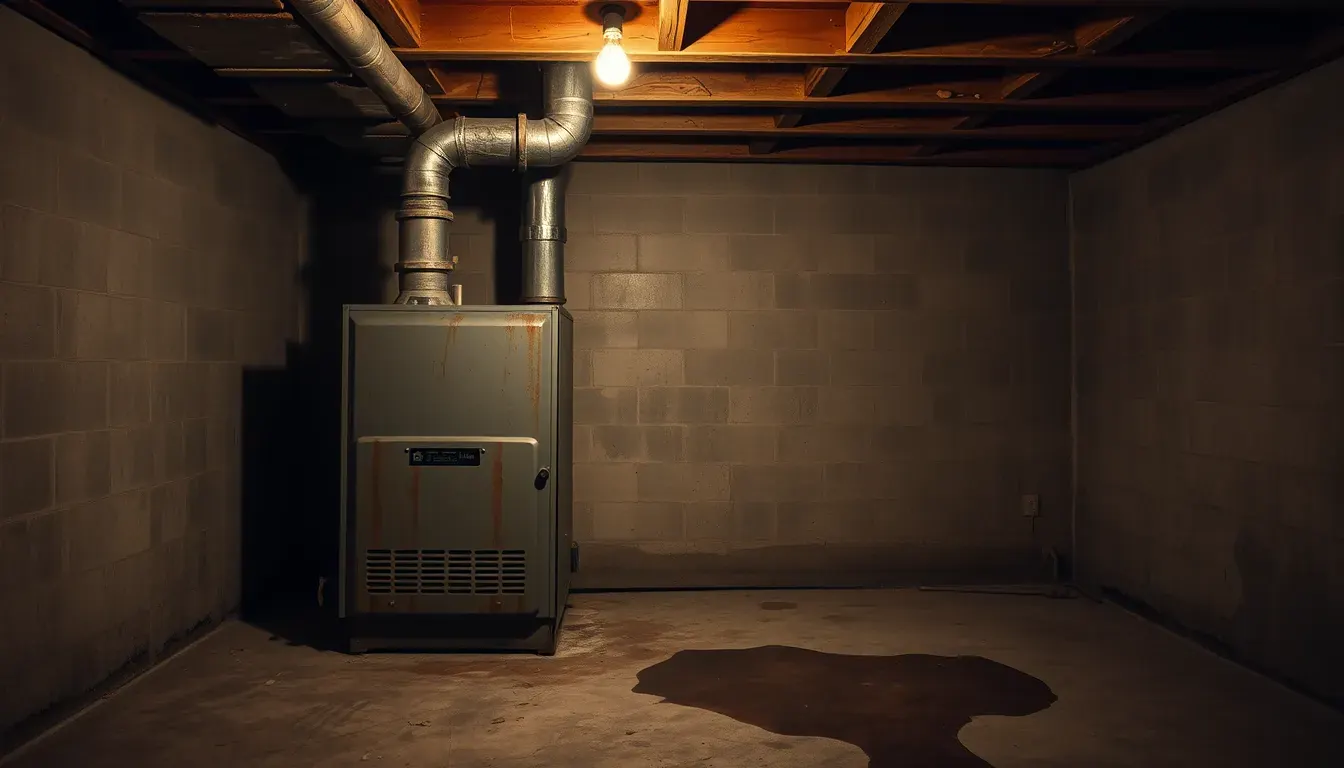
Would you replace a 27-year-old furnace with rust and water damage?
Every benchmark in this guide points to planning the replacement now. At 27, the furnace is past ENERGY STAR's 15-year mark, every 15 to 20 year range above, and the 21.5-year average in the DOE rule. The rust is the reason not to wait for a winter breakdown, which CBS News says tends to cost more.
Until it goes, find out where the water came from and what it reached. The Oxbox manual says any corroded section of vent pipe must be replaced, and a furnace with any part under water should not be used. Rust on the vent is the manual's case for replacing that section of pipe. Our furnace carbon monoxide guide covers what that check involves.
Old furnaces can hide asbestos. The EPA lists oil and coal furnaces and door gaskets with asbestos insulation among the places it may be found. Its advice: if in doubt, treat the material as if it contains asbestos and leave it alone, and have removal done by people trained to handle it. If your old unit burns oil or coal, ask the installer how they will remove it.
Bad circuit board: do you need to replace the entire furnace?
Usually not. The control board is a replaceable part. Fixr reports $390 to $725 for a control board replacement, including the service call. On a furnace still under its parts warranty, the board may be covered and you pay for labor.
A discontinued board is not always the end either. Universal boards exist for many single-stage furnaces with hot surface ignition. The White-Rodgers 50M56X-843 spec sheet says it replaces over 550 part numbers and includes a 120-volt nitride igniter. The board carries its own 1-year limited warranty.
Two cautions. Ask whether the board itself failed or only its fuse blew; the Oxbox manual lists a blown control board fuse among its basic checks. And a new board on a furnace with other problems, such as a rusted vent or a suspect heat exchanger, only delays the bigger decision.
Is a 2.5-year-old furnace really ruined?
Rarely from age alone. A furnace that young is inside the 5-year default parts warranty from both Carrier and Goodman, and inside the 10-year term if it was registered. So the first questions are what failed and whether the warranty covers it.
The manual's warnings point to what can damage a young furnace: floodwater, corrosive vapors pulled into the burners, and construction dust. The Oxbox manual says running the furnace during construction voids its warranty. Read the exclusions in your own model's warranty certificate.
If a contractor says the furnace is ruined, ask for the failed part, photos and readings in writing. Then call the manufacturer with the serial number. If the claim is a cracked heat exchanger, get a second opinion; our cracked heat exchanger guide explains how.
Safety limits while you decide
- Do not run a furnace that has been under water until a qualified technician has inspected it and replaced the wet parts.
- Leave the burners, gas valve and wiring to a licensed technician. The Oxbox manual says the furnace has no user-serviceable parts.
- Do not disturb old insulation, gaskets or pipe wrap that might contain asbestos.
- Refrigerant work on the AC side needs an EPA Section 608 certified technician.
- Keep CO alarms working on every level and outside sleeping areas, as the CPSC advises, until the old furnace is gone.
Call a pro now if
- You smell gas or a CO alarm goes off. Leave first, then call.
- The furnace or its controls were under water.
- A technician shut the furnace off or reported a cracked heat exchanger.
- The vent pipe is rusted through, disconnected or no longer slopes upward.
- The burner flames are not bright blue (the Oxbox manual allows only occasional yellow streaks).
- You have no heat in freezing weather. Our no heat checklist covers what to check while you wait.
Questions people ask
How long does a furnace last on average?
Most sources put a gas furnace at 15 to 20 years, including Lennox, Carrier and Fixr. The Department of Energy's 2023 furnace rule uses an average of 21.5 years for non-weatherized (indoor) gas furnaces. ENERGY STAR suggests considering a replacement once a furnace passes 15 years. Lennox says electric furnaces last 20 to 30 years.
Should I replace my furnace and AC at the same time?
Often, if both are old. ENERGY STAR suggests considering a new air conditioner after 10 years and a new furnace after 15. AHRI rates split systems as matched combinations, and Carrier advises against replacing only the outdoor unit. If your AC is young, replacing only the furnace can work. Ask the installer to confirm the new furnace matches your coil and outdoor unit.
Is it worth repairing a 20-year-old furnace?
For a cheap part, often yes. A $178 igniter, the top of Fixr's range, scores $3,560 on the $5,000 rule. For a blower motor or a heat exchanger, the rule says replace. Either way, a 20-year-old furnace is past ENERGY STAR's 15-year mark, so get replacement quotes before it fails in the cold.
Does a bad circuit board mean I need a new furnace?
Usually not. The control board is a replaceable part, and Fixr reports $390 to $725 for the job. Universal boards fit many single-stage furnaces with hot surface ignition; White-Rodgers says one model replaces over 550 part numbers. On a young furnace, check whether the parts warranty covers the board.
Is there a tax credit for a new furnace in 2026?
No. The IRS says the Energy Efficient Home Improvement Credit covers improvements made through December 31, 2025. Through 2025 it allowed up to $600 for a qualifying furnace. For a 2026 install, look for utility rebates in the ENERGY STAR Rebate Finder and ask your gas utility.
Can I replace an 80 percent furnace with a 95 percent one?
Yes, but plan for the venting. A training presentation posted by the Department of Energy says condensing furnaces need PVC venting and will not connect to the existing vent. If your gas water heater shared the old vent, it can be left on a vent that is far too large, which can cause CO problems. Ask how the quote handles it.
Sources
- ENERGY STAR: Heat and Cool Efficiently, When to Replace
- U.S. Department of Energy: Energy Conservation Standards for Consumer Furnaces, final rule, 88 FR 87502 (December 18, 2023)
- U.S. Department of Energy: Energy Saver 101, Everything You Need to Know About Home Heating
- U.S. Department of Energy: Workshop presentation on condensing appliances and orphaned water heaters (October 2014)
- Lennox: How Long Does a Furnace Last?
- Carrier: How Much Does HVAC Replacement Cost?
- Carrier: Warranty Registration and Information
- Goodman: HVAC Learning Center, Warranty
- Trane Technologies: Oxbox Single Stage and Two-Stage Gas Furnaces User's Manual
- AHRI: How and Why Certified
- Penn State EGEE 102: 10.5 Types of Air Conditioners
- White-Rodgers by Copeland: 50M56X-843 Single Stage HSI Integrated Furnace Control spec sheet
- Fixr: Furnace Repair Cost
- Fixr: How Much Does a New Furnace Cost?
- This Old House: HVAC Replacement Cost
- CBS News: What is the $5,000 rule for HVAC systems?
- CBS News: How much does a new HVAC system really cost in 2026?
- NC State Extension: How to Salvage Flood-Damaged Appliances
- EPA: Learn About Asbestos
- EPA: Protect Your Family from Exposures to Asbestos
- EPA: Section 608 Technician Certification
- CPSC: Carbon Monoxide Questions and Answers
- CPSC: Carbon Monoxide Information Center
- IRS: Energy Efficient Home Improvement Credit
- ENERGY STAR: Rebate Finder