A furnace leaking water usually has a drain problem, not a broken furnace. On a high-efficiency furnace, the condensate trap, drain line or pump has clogged, frozen or failed. If it leaks only while the AC runs, the AC's evaporator coil drain is the usual suspect. A whole-house humidifier is the third usual source. If water is near the wiring, turn the furnace off before you trace it.
A condensing furnace makes real water. Carrier says condensing furnaces are generally rated 90 to 98 percent AFUE, and that a 60,000 BTU/h furnace at full input can produce roughly 0.7 gallons of water vapor an hour. American Standard lists a furnace condensate pump repair at $250 to $440. The EPA says to dry wet materials within 24 to 48 hours to prevent mold.
Why is my furnace leaking water?
Start with what kind of furnace you have. The Oxbox user's manual, published by Trane Technologies, describes two kinds. Non-condensing furnaces run about 80 percent AFUE and vent through a metal pipe or a masonry chimney. Condensing furnaces run over 90 percent AFUE, vent mainly through plastic PVC pipe, and "produce liquid condensate which is slightly acidic."
So look at the vent, then confirm the AFUE on the furnace's label or in its manual. In the Oxbox description, plastic PVC vent pipe goes with a condensing furnace, and a metal pipe or masonry chimney with a non-condensing one. A contractor quoted on Bryant's page puts it plainly: "A furnace itself would only be leaking water if it is a high-efficiency unit." Bryant adds that a high-efficiency furnace typically makes a few gallons a day during heating.
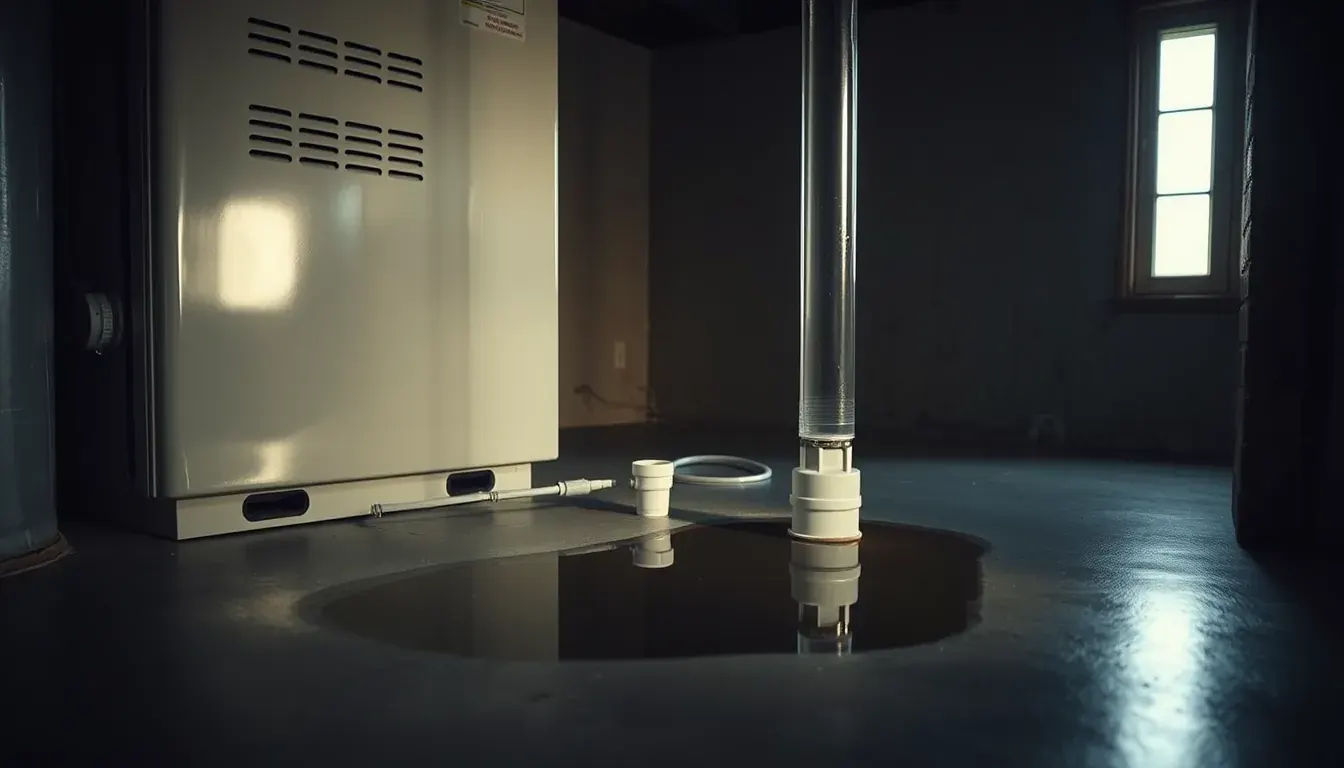
On a condensing furnace, that water follows a set path. Goodman's installation manual for its 97 percent modulating furnaces says the condensate collects in the furnace drain trap and must be routed to a drain. The trap must be primed with water at installation. The drain line must slope down a quarter inch per foot and be protected anywhere it can freeze. A break anywhere in that path puts water on the floor.
A standard furnace has no condensate path, so water around it usually comes from something attached to it. Bryant calls water at the indoor unit during cooling an AC condensate issue, and lists a leaking humidifier as a separate cause. The AC coil can be installed right with the furnace. Goodman's manual covers a coil sharing the furnace's drain, and Lennox's coil manual sets a minimum gap between the coil's drain pan and the furnace heat exchanger.
What the leak usually means
Match where and when you see the water. These causes come from the Carrier, Bryant, Goodman, Lennox, Little Giant and Aprilaire documents cited in this guide.
| Where and when | Likely source | Who fixes it |
|---|---|---|
| Puddle at the base during heating, condensing furnace | Clogged trap or drain line, or a loose, kinked or cracked drain hose | You: the outside hose. Pro: the trap and hoses inside the cabinet |
| Water around a small pump box near the furnace | Condensate pump unplugged, failed, or its discharge tubing clogged | You: power and tubing. You or a pro: a new pump |
| Furnace shut off in a freeze, outdoor drain line iced | Frozen condensate line backing water up | Pro: reset the drain switch and add freeze protection |
| Only while the AC runs | Clogged coil drain, a frozen coil, or a cracked or rusted drain pan | You: filter and drain flush. Pro: coil and refrigerant |
| Water dripping from a second, overflow drain pipe | The coil's overflow line: the main drain is blocked | You or a pro: clear the main drain |
| Water on the duct or floor below a humidifier | Humidifier drain line, feed tube, fittings or valve | You: close its water valve. Pro or you: drain line and parts |
| Water at a metal vent pipe or chimney connection | Condensation in the vent or chimney | Pro, because the vent carries carbon monoxide |
| Water inside the cabinet near the blower or control board | Coil pan or humidifier leaking into the furnace, or a backed-up drain | Pro |
What to do right now: safe checks
- Shut it down. Set the thermostat to off. If water has reached wiring, the control board or the blower, turn off the furnace power switch or breaker, but only from a dry spot.
- Stop the damage. Put down a bucket and towels, as Carrier suggests, and wet-vac standing water. The EPA says materials dried within 24 to 48 hours usually do not grow mold.
- Note when it leaks. During heat, during cooling, or with the system off. That points you to a row in the table above.
- Check the filter. Carrier links dirty filters to frozen AC coils that drip as they thaw. ENERGY STAR says to inspect, clean or change filters once a month.
- Follow the drain line. Trace the tubing from the furnace or coil to the floor drain or pump. Look for kinks, a loose end, or a low spot that holds water. The Oxbox manual says owners "must make sure the condensate drain lines do not become blocked, pinched or crushed."
- Check the pump. Confirm it is plugged in and its breaker has not tripped, the first causes in Little Giant's troubleshooting table. Make sure its discharge tubing is not kinked. Little Giant's manual describes a float test with the cover off; follow your own pump's manual for it.
- Check the humidifier. If water runs from it, close its water valve. Aprilaire's manual says to disconnect power and shut off the water supply before servicing.
- Look outside in freezing weather. If a drain line runs outdoors and is iced, do not thaw it with a flame. Bryant says so directly.
Leave the inside of the furnace alone. Carrier's checklist says to look for standing water but "do not disassemble internal components." Bryant also says to avoid opening the furnace cabinet or repairing internal parts yourself. Take the trap apart only if your owner's manual shows how.
Furnace leaking water from the bottom: trap, drain and dripping sounds
On a condensing furnace, water at the bottom usually means the trap or its hoses. Goodman's manual shows separate hoses draining the vent elbow and the collector box into one trap. Bryant notes these leaks often "appear shortly after a new furnace installation or after service has been performed."
If you hear dripping inside the cabinet, note that Bryant's technician troubleshooting guide lists "Water in vent piping, possible sagging pipe" and a "Plugged condensate drain" among the causes of pressure switch faults, so that water can also stop the furnace. If it also starts, stops and flashes a code, see our guide to furnace pressure switch problems. For other sounds, see furnace noises.
Cold weather adds a cause. The Oxbox manual says drain lines that run outdoors need insulating where temperatures fall below freezing. If condensate freezes in the lines, a condensate drain switch shuts the furnace down, and "only a licensed HVAC technician can reset this switch." Until then you have no heat, so treat a frozen line as a service call.
Why is my furnace leaking water when the AC is on?
Then it is an AC leak that lands on the furnace. Bryant calls it "an air-conditioning condensate issue rather than a furnace condensate issue." The evaporator coil pulls water out of the air, drips it into a pan, and drains it away. Carrier names the usual failures: a clogged drain line, a frozen coil, and a drain pan that has corroded or cracked.
A frozen coil drips when the ice melts. Carrier says dirty filters and low refrigerant restrict airflow and cause the freezing. You can change a filter. Low refrigerant is a technician's job, and EPA rules require technicians who service equipment that could release refrigerant to be certified under Section 608.
A clogged drain line tops Carrier's list. Its drain cleaning guide says to turn the system off, then vacuum the clog from the outdoor end with a wet/dry vac, or pour a cup of distilled vinegar into the indoor access point. Carrier's leak page adds a limit: do not use a wet/dry vac if you are unsure which line is the condensate drain.
Shared drains cause their own floods. Goodman's manual lets the AC coil drain into the furnace's drain, but only with an open tee vent "to prevent air conditioning condensate from backing up into the furnace if the common drain was blocked."
The pan's position matters too. Lennox's coil manual says the drain pan must sit at least 2 inches from a standard gas furnace heat exchanger, and that "closer spacing may damage the drain pan and cause a leak." That is for an installer to check.
Lennox G40UH leaking into the furnace cabinet, drains dry
A question homeowners post online: a Lennox G40UH leaks water into the furnace cabinet with the AC on, yet the condensate drains are dry. A copy of Lennox's brochure rates the G40 at 80 percent AFUE, and the Oxbox manual describes furnaces around 80 percent as non-condensing. Bryant calls water at the indoor unit during cooling an AC condensate issue, and lists a leaking humidifier as a separate cause.
On the coil side, Lennox's coil manual tells installers to confirm the pan's drain opening "is fully open and free of any debris," and warns that a pan set too close to the heat exchanger may be damaged "and cause a leak." Carrier lists a corroded or cracked drain pan among the usual AC leaks. Carrier also says homeowners should "not disassemble internal components," so leave the pan and coil to a technician.
Water coming out of the overflow pipe
Many AC coils have two drain outlets. Lennox's coil manual says the main drain goes to a drain line or sump, and the overflow drain line "should run to an area where homeowner will notice drainage." Where an overflow line cannot be run, Lennox calls for an overflow switch wired to shut down the compressor.
So water coming out of the overflow line, wherever it ends, means the main drain is blocked and the pan is filling. The overflow is doing its job. Clear the main drain before the overflow clogs too. Carrier adds that a safety float switch in the pan "triggers the system to shut down completely" when the pan fills. That is why the AC can quit with water standing in the pan.
Local code governs these drains. In Austin, the City's final mechanical inspection checks that condensate drains to an approved location, with a secondary drain or pan suited to the unit. Our Austin page covers that checklist.
How a condensate pump works, and why it leaks
When no floor drain sits low enough, the water goes to a condensate pump. Little Giant's owner's manual for its VCMA series says the pump removes condensate from an AC coil, a condensing furnace or a condensing boiler, with a float switch that starts and stops the motor. The VCMA-15 spec sheet lists a half-gallon tank, three inlet openings, and a discharge fitting with a built-in check valve.
Models with an S in the number add a high-water switch. The manual says it comes set to open the thermostat circuit when the tank fills, which stops the system from making more condensate. An installer can rewire it to sound an alarm instead. If your pump has this switch wired in, a full pump can be the reason the furnace or AC quit.
The manual's troubleshooting table lists why a pump overflows:
- No power: unplugged, or a tripped breaker. The manual says to give the pump its own circuit and not to connect it to "a fan or any device that runs intermittently."
- A dirty float that "could be too heavy to operate correctly," or something blocking its path.
- A pump that is not level, so the float does not trigger.
- A stuck or plugged check valve, or discharge tubing that is kinked or clogged with slime.
- More water coming in than the pump can move, or a lift too high for it.
- A failed motor or switch. For both, the listed fix is to replace the pump.
A pump that cycles on and off nonstop usually has a leaking check valve, per the same table. On a new pump, the manual warns that leaving the cardboard shipping insert in place "will cause the pump to not function as intended, possibly resulting in an overflow."
Upkeep is simple. The manual says to inspect and test the pump every 6 months. Unplug it, check that the floats move, backwash the check valve, wash the tank with warm water and mild soap, and flush it with fresh water. The flush matters on a furnace. The manual says condensate in a gas furnace setting must not fall below an average pH of 3.4, and routine flushing keeps acid from pitting the tank.
What condensate pump do I need?
Match four things. Little Giant's documents serve as the example here; check the same lines on any brand.
- Rated for furnace condensate. The VCMA-15 spec sheet says it is "suitable for high efficiency oil and gas-fired condensing furnace" equipment.
- Enough lift. The VCMA-15 moves 65 gallons an hour at 1 foot of lift, 25 at 10 feet, and none at 20, with a 15-foot shutoff. The manual says not to run the discharge higher than 75 percent of the pump's rated head.
- A safety switch. Choose a model with a high-water switch and have it wired to shut the system down.
- Temperature and cord. The spec sheet lists a maximum water temperature of 140°F. The manual says the power cord cannot be replaced; if it is damaged, the whole pump is.
Is the humidifier the leak?
A furnace-mounted humidifier is plumbed to a water line, and drain-type models also have a drain tube. Aprilaire's owner's manual says that on its drain-type models, "there will be a small, steady stream of water to drain" whenever the humidifier runs. Water moving through its drain tube during a heating call is normal. Water spilling from the housing, the duct or the fittings is not.
The manual's service steps show where leaks start. It has you check the water feed tube for cracks, make sure the small orifice is unplugged, and double-wrench the fittings "to prevent leaking." It says the drain line needs a constant downward slope and must not be flattened or blocked. It also calls for a new water panel at least once a year, or twice a season on its Models 400 and 400M.
If the humidifier will not shut off, Aprilaire says to turn its control to "Off" and call a heating contractor if it keeps running. Shut off its water and power before you touch anything. Bryant's technician guide shows why this matters: for a failed blower motor, it says to look for water damage and "Check A-coil and/or humidifier."
Water at the vent pipe or chimney
Water at a metal vent pipe is the leak to take most seriously. Goodman's installation manual for its 80 percent furnaces warns that "damaging condensation can occur inside masonry chimneys" when one of these furnaces is vented without adequate dilution air. It says not to connect one to a masonry chimney unless the chimney has a metal liner or Type B vent, or a draft-hood appliance shares it.
Even when the furnace shares the chimney with a draft-hood appliance, the manual says condensation damage may still occur with extremely cold weather, long vent connectors or exterior chimneys. The vent carries carbon monoxide, so a wet or rusted vent is a safety repair, not a drip to mop. The Oxbox manual says any corroded section of vent pipe must be replaced, and masonry chimneys should be inspected and relined if needed by a licensed technician. Our furnace carbon monoxide guide covers the warning signs.
Is a furnace leaking water dangerous?
It can be. Carrier answers, "Yes, a furnace leaking water can be an emergency," and says not to run a furnace if that could expose electrical parts to water. Bryant's technician guide tells techs to inspect failed blower motors and control modules for water damage.
Water also feeds mold. The EPA says to fix leaks as soon as possible and to dry water-damaged areas within 24 to 48 hours. It also says to keep air conditioning drip pans clean and drain lines flowing.
Carbon monoxide is a separate question. Bryant says a cracked heat exchanger is "not a typical cause of a furnace condensate leak," though it is a serious hazard. Carrier's page lists a breach in the heat exchanger as a possible cause and says homeowners should not inspect or repair it. If a technician raises it, read our guide to cracked heat exchangers before you agree to anything.
How much does it cost to fix a furnace water leak?
Most fixes are drain work, not furnace parts. Published ranges differ, so use them to check a quote, not as a price.
| Repair | Reported cost | Source |
|---|---|---|
| Furnace condensate pump | $250 to $440 | American Standard |
| Condensate pump replacement, installed | $150 to $1,000, $400 average | PICKHVAC |
| Condensate drain tube (AC or heat pump) | $100 to $195 | American Standard |
| Drain line replacement | $40 to $240 per 10 feet | PICKHVAC |
| Drain pan (AC or heat pump) | $150 to $350 | American Standard |
| Replacement evaporator "A" coil on a furnace | $550 to $2,500 | American Standard |
| Fixing an AC water leak, overall | $200 to $1,500 | Carrier |
| Diagnostic visit | $50 to $200 | American Standard |
| Labor | $75 to $150 an hour | American Standard |
The sources do not line up. American Standard, which says it compiled industry averages with help from Forbes, lists an AC condensate pump at $100 to $165 but a furnace condensate pump at $250 to $440. It also says emergency rates can run two to three times the regular hourly rate. PICKHVAC's pump figure covers the pump, a float kit and installation, and assumes Midwest labor at $75 to $125 an hour.
Carrier puts most AC leak repairs at $200 to $1,500, and says clearing a clogged line is generally affordable while coil damage costs more. Ask for a written, itemized quote that names the cause: a cleared trap, a new pump, a re-sloped drain or coil work. Our guide to checking an HVAC quote covers what to compare.
Ask about warranties too. Little Giant's manual gives its VCMA pumps a 12-month limited warranty from purchase. Ask what the installer's labor warranty covers on top of that.
Should you replace an old furnace with rust and water damage?
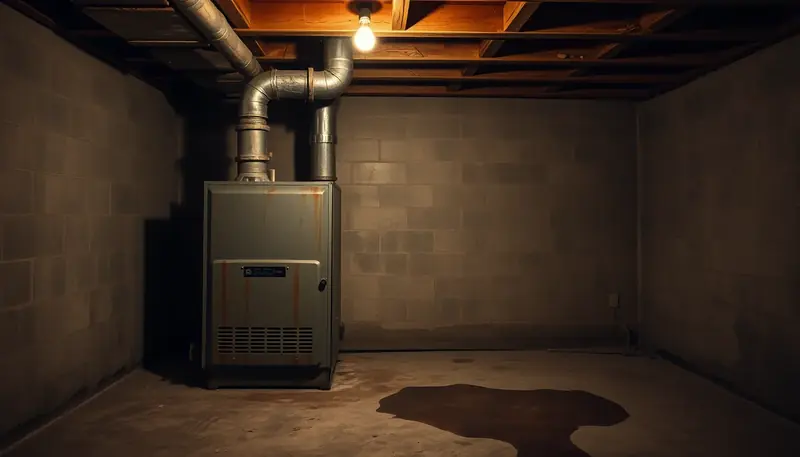
Rust and water staining on an old furnace raise a bigger question than the drain. Carrier says heat exchangers can last about 15 to 20 years with proper maintenance. First find where the water came from and what it reached. The Oxbox manual says not to use a furnace if any part has been under water. Our guide to repairing or replacing a furnace works through the decision.
Call a pro now if
- Water has reached the control board, wiring or blower motor.
- Your CO alarm sounds, or anyone gets a headache, dizziness or nausea while the furnace runs. Get everyone outside first.
- You smell gas.
- Water drips from a metal vent pipe or chimney connection, or the vent is rusted.
- The condensate line froze and the furnace shut down. The Oxbox manual says only a licensed technician can reset the drain switch.
- The AC coil is still icing over after you changed the filter. Low refrigerant is the other cause Carrier names.
- Water is inside the cabinet with dry drains, or the leak returns after you cleared the line and checked the pump.
- Any part of the furnace has sat in water.
Yearly service catches most of this early. The CPSC recommends having the heating system professionally inspected and serviced every year. ENERGY STAR puts the condensate drain on its checklist because "a plugged drain can cause water damage in the house and affect indoor humidity levels." Our furnace tune-up guide covers what a visit should include.
Questions people ask
Is it normal for a furnace to leak water?
Making water is normal for a high-efficiency furnace. Leaking it is not. Carrier says condensing furnaces rated 90 percent AFUE or higher produce condensate, roughly 0.7 gallons of water vapor an hour for a 60,000 BTU/h furnace at full input. That water belongs in the drain. A standard 80 percent furnace makes no condensate to drain, so check the AC coil, humidifier and vent.
How much is a condensate pump?
American Standard lists a furnace condensate pump repair at $250 to $440, using industry averages it compiled with help from Forbes. PICKHVAC reports $150 to $1,000 installed, with $400 as its average, assuming Midwest labor rates. American Standard puts a diagnostic visit at $50 to $200. Ask for a quote that separates the pump from any drain line work.
Why is my condensate pump leaking?
Little Giant's manual lists the usual reasons a pump overflows: no power or a tripped breaker, a dirty float that sticks, a pump that is not level, a stuck check valve, or discharge tubing that is kinked or clogged with slime. If the motor or switch has failed, the manual says to replace the pump. A pump that cycles nonstop often has a leaking check valve.
Should I turn off my furnace if it is leaking water?
If water is near the wiring, control board or blower, yes. Carrier says not to run the furnace if that could expose electrical parts to water, and says a leaking furnace can be an emergency. Turn it off at the thermostat, then at the furnace switch or breaker if you can reach it without standing in water.
Can a frozen condensate line make a furnace leak?
Yes. Ice blocks the drain, so water backs up and can spill at the furnace. The Oxbox user's manual says a frozen line trips the condensate drain switch and shuts the furnace down, and only a licensed HVAC technician can reset that switch. Bryant warns never to thaw a frozen line with an open flame.
Does a leaking furnace mean carbon monoxide?
Usually not. Bryant says a cracked heat exchanger is not a typical cause of a condensate leak. Water at a metal vent pipe or chimney connection is different, because it points to the venting. If a CO alarm sounds, the CPSC says to get outside, call 911 or the fire department from there, and stay out until responders say it is safe.
Sources
- Carrier: Furnace Leaking Water: Causes, Signs, and Solutions
- Bryant: Why Is My Furnace Leaking Water?
- Carrier: Why Is My AC Leaking Water?
- Carrier: How to Clean AC Drain Line
- Trane Technologies: Oxbox Single Stage and Two-Stage Gas Furnaces User's Manual
- Goodman (Daikin Comfort): DVM97 and RVM97 Modulating Gas Furnace Installation Instructions, IOG-2045
- Goodman (Daikin Comfort): RVT80 and DVT80 Category I Gas Furnace Installation Instructions, IOG-2043
- Bryant (Carrier): 355MAV Series H Troubleshooting Guide SM05-5
- Lennox: CRX35 Series Coils Installation Instructions 508355-01
- Lennox: Merit Series G40 Gas Furnace brochure (ManualsDir copy)
- Little Giant (Franklin Electric): VCMA Condensate Pump Series Owner's Manual
- Little Giant: VCMA-15 Series Condensate Pump Spec Sheet
- Aprilaire: Humidifier Owner's Manual for Models 350 to 700M
- ENERGY STAR: Heating and Cooling Maintenance Checklist
- EPA: A Brief Guide to Mold, Moisture and Your Home
- EPA: Section 608 Technician Certification
- CPSC: Carbon Monoxide Questions and Answers
- American Standard: Average HVAC Repair Cost: Furnace, AC, and Heat Pump
- PICKHVAC: AC Valve, Drain Line and Condensate Pump Replacement Cost 2026